
Guide
The best time to visit Himachal Pradesh
Himachal is not one climate, it is about five stacked on top of each other. The month that gives you snow in Manali is the month Spiti is shut, and the month Spiti is at its best is the month the Kangra valley is washing out. Here is what each part of the year actually gives you.
Written by the people who drive these roads · Last checked September 2026
The short answer
For a first trip, come between March and June — everything is open, the passes clear from late May, and the valleys sit around 15–28°C. For snow, come in January rather than December. For Spiti, come between June and September, which is the one window when the monsoon everywhere else works in your favour. Avoid July and August anywhere low-lying in Kangra or Mandi unless you are relaxed about losing a day to a blocked road.
Read the full guideClose the guide
The one thing to understand first
Most advice about Himachal treats it as a single destination with a single best season. It is not. Shimla sits at about 2,200 metres on the outer range, three hours from the plains. Kaza sits at about 3,650 metres behind the main Himalaya, two days further on. They get different weather on the same day, and their good months barely overlap.
So the honest answer to “when should I come” is another question: what do you actually want out of it? Snow, green valleys, high passes and empty roads are four different trips, and three of them are impossible at once.
One correction worth making early, because it is written wrongly almost everywhere: Manali is lower than Shimla, not higher. Manali town sits around 2,050 metres, Shimla around 2,200. Manali gets the heavier snow anyway, because it sits at the head of the Kullu valley with the Pir Panjal wall directly above it, catching weather that Shimla lets through. Altitude is not the reason, and guides that tell you it is have not been to either.
March to June — the default answer
This is the season most people should book, and the one we drive most.
Valleys run roughly 15–28°C by day and cool off properly at night. The rhododendron is out through March and April. Everything at normal altitude is open, and the high passes clear from late May, which is when the Rohtang side and the road towards Lahaul come back into play. If you want the big loop — Dharamshala, Shimla, Manali, Kullu — this is when it runs at its easiest.
The catch is other people. Mid-May to mid-June is the Indian school holiday, and it is the single busiest stretch of the Himachal year. The approach into Manali can crawl, hotel rates go up, and the places everyone photographs have queues. March, early April and the first half of May give you most of the same weather with a fraction of the traffic.
For a honeymoon, April and early June are the sweet spots: warm enough to sit outside at night, quiet enough to hear something other than car horns.
July to September — the monsoon, and the exception
For most of Himachal this is the season to be careful about. The rain concentrates on the outer ranges, which is exactly where Kangra, Mandi and Kullu are. It is extraordinarily green, the waterfalls are running, and hotels are the cheapest they get all year. It is also when the hillsides move. Roads get blocked, usually cleared within hours, occasionally not.
None of that is a reason to stay away if you have time. It is a reason not to plan a tight five-day itinerary with a flight to catch at the end of it.
And then there is Spiti, which runs on the opposite calendar. Spiti sits behind the main Himalayan range in its rain shadow — it is high desert, and it gets very little of the monsoon at all. So the months that wash out Kangra are the months Spiti is dry, warm in the sun, and fully open. June to September is the Spiti window, and July and August sit right in the middle of it. The same is true of the road up to Leh.
If you have been to Himachal before and want somewhere that does not feel like Himachal, this is the time and Spiti is the place.
October and November — the quiet best
If we had to pick one month for ourselves, it would be October.
The rain has gone, the air is scrubbed clean, and the views are as sharp as they get all year — this is when you can actually see the Dhauladhar properly from Dharamshala instead of guessing where it is. Days are mild, nights get cold fast once the sun drops behind the ridge. The crowds have thinned out.
It is the best month for trekking and for photography, and it is a good month for the long driving routes because nothing is either flooded or frozen.
The one constraint is Spiti, which starts closing from late October as the passes ice up. If Spiti is in your plan, October is the tail end and you want the first half of it, not the last.
December to February — snow, with conditions
Cold, 0–12°C, and the season people write to us about most.
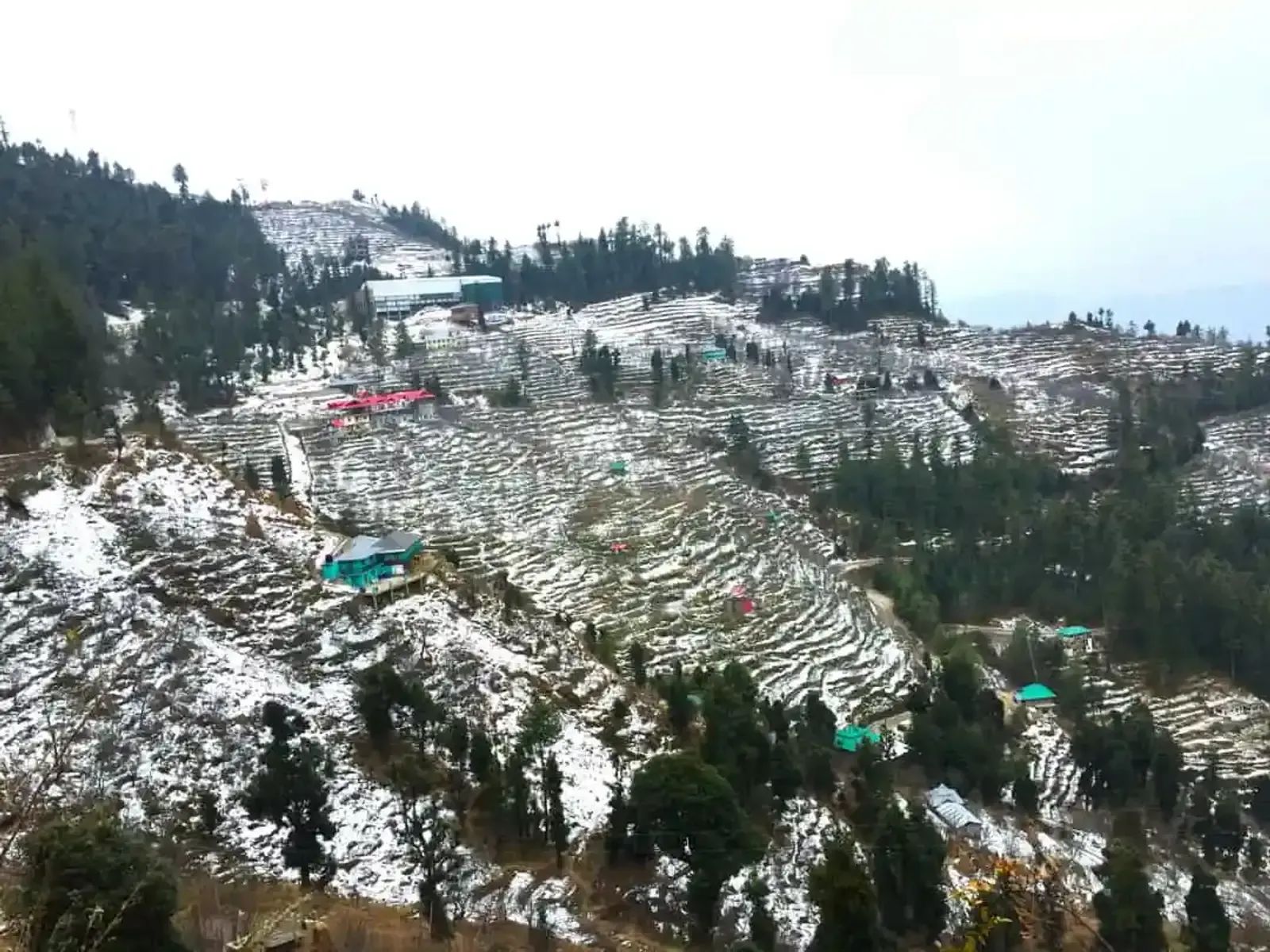
Snow falls in Shimla, Manali, Dalhousie and Khajjiar, and the main roads are kept open and cleared. The high passes are shut, so Spiti’s Manali approach and the Leh road are out entirely.
The thing worth knowing: January is more reliable than December. December gets the bookings because of New Year and the school holidays, but early-season snow at Shimla’s altitude frequently falls and melts inside two days. By January the cold has properly set in. If someone in your group has never seen snow and that is the point of the trip, book January and you will be much less likely to be disappointed.
New Year itself is the second peak of the Himachal year. Shimla and Manali fill up, rates roughly double, and the roads in are slow. It is a good time to come if you want the party. It is a bad time to come if you want the mountains.
Quick answers
- First trip, no strong preference — March to June, ideally outside mid-May to mid-June.
- Snow — January, into early February.
- Spiti or the Leh road — June to September. Nothing else works.
- Trekking — May to early June, then late September through October.
- Fewest people — February, or the second half of September.
- Cheapest — July and August, and you will know why.
- Honeymoon — April, early June, or October.
- Families with young children or older parents — March to April, or October. Short drives, mild weather, no altitude to worry about.
And if the month you have is the wrong one
Most people cannot pick their dates freely. Leave is leave.
That is usually solvable — not by pretending a bad month is a good one, but by changing where you go inside it. August is poor for the Kangra valley and excellent for Spiti. December is unreliable for snow at Shimla and fine at higher elevation. Late June is chaos in Manali and quiet in Chamba.
If you tell us the fortnight you can actually travel, we will tell you what works inside it, including when the honest answer is that you should go somewhere else in the state entirely.
Also asked
Questions that come up
Which month has the most reliable snow?
January. December gets asked about far more often, because of New Year, but it is the less reliable of the two — early snow at Shimla's altitude often falls and goes within a couple of days. By January the cold has settled in and what falls tends to stay. If snow is the whole reason for the trip, January into early February is the safer booking.
Is July a good time to visit Himachal Pradesh?
It depends entirely on which part. July in Kangra, Mandi or Kullu is the wettest stretch of the year and the one when roads are most likely to be blocked for a few hours. July in Spiti is close to perfect — it sits behind the main range in a rain shadow and stays dry while everywhere else is soaked. So July is a bad month for a general Himachal trip and one of the best months for a Spiti one.
When should I not come?
Late July and August, if your trip is short and fixed. The scenery is at its greenest and the hotels are at their cheapest, but that is the trade — the risk of losing half a day to a landslide clearance is real, and with only four or five days there is no slack to absorb it. With ten days and a flexible attitude it is genuinely a good time to travel.
When is it least crowded?
Late January through February, and the second half of September into early October. Both give you clear air and open roads without the school-holiday traffic. Avoid mid-May to mid-June and the week around New Year if crowds are what you are trying to escape — those are the two peaks, and Manali in particular can back up for hours on the approach road.
Keep reading