
Narkanda, Kotgarh and the apple belt
Sixty-five kilometres past Shimla the hill stations stop and the orchards start. Three days in the country an American called Satyanand Stokes planted with apples in 1916, and a road to a temple at 3,400m.
- Narkanda
- Hatu Peak
- Kotgarh
- Thanedar
- Tani Jubbar
Good for — Blossom in April, picking in September, and anyone who wants Shimla's hills without Shimla
Read the full descriptionClose the description
Everybody knows Shimla and almost nobody carries on past it. Sixty-five kilometres further along the same highway the ridge stops being a town and becomes a horticultural district, and the difference between the two is one of the sharpest in Himachal.
This is a small trip with a specific shape: a high road to a temple, a lake, and two days among orchards. It is also the most seasonal thing we run, because the whole point of it happens twice a year and not in between.
What Stokes did, and why the whole district looks like this
Samuel Evans Stokes was an American who came to Kotgarh in the early 1900s, stayed, married locally, converted to Hinduism in 1932 and took the name Satyanand.
In 1916 he planted a strain of apple developed by the Stark brothers in the United States, having worked out that it would suit these hills. It did. His neighbours copied him, then their neighbours did, and inside two generations the economy of this part of Shimla district had been rebuilt around a fruit that had not previously grown here.
That is not a decorative anecdote about the place. It is the reason there are orchards on every south-facing slope from Kotgarh to the Sutlej, and it is why the apple is now the largest horticultural export Himachal has. You are driving through the result of one man’s agricultural experiment and it is roughly a hundred kilometres wide.
Hatu, and the case for going early
The Hatu road leaves the highway at Narkanda and climbs 8km of tarred single track to a shoulder just under the summit at 3,400m. There is a small wooden temple at the top with a heavy slate roof and stone walls, and a walkway up to it.
Go at seven. Two reasons, and neither is the crowd.
The first is that the view is east into Kinnaur, so the light is behind the range in the afternoon and on it in the morning. The second is cloud: this ridge builds its own by about eleven from May onwards, and a peak that was showing a hundred-kilometre horizon at eight is inside a grey box at midday.
The other reason to be here in September
Picking season is the best few weeks in this district, and not because of the fruit.
The whole place goes to work. Trucks queue on the highway, crates stack at the roadside, the mandis run late, and every orchard has ladders in it and families up them. It is the most alive rural Himachal gets, and you are welcome to stand in the middle of it — the growers are used to visitors and generally pleased to explain what they are doing.
You will also be given apples. Take them.
Where we would put you
Narkanda has hotels of the ordinary Himachal sort and they are fine. The better answer, if you are here in either of the two seasons, is an orchard homestay around Kotgarh or Thanedar, where you are on the farm rather than on the highway.
They are small, they book out in September, and the standard varies. We will tell you which one we would put our own family in, and if you would rather have a reliable hot shower than a working orchard we will book Narkanda instead and say nothing more about it.
Day by day
How the 3 days run
- Day 13.5–4 hrs from Chandigarh, then 2 more
Up to Narkanda
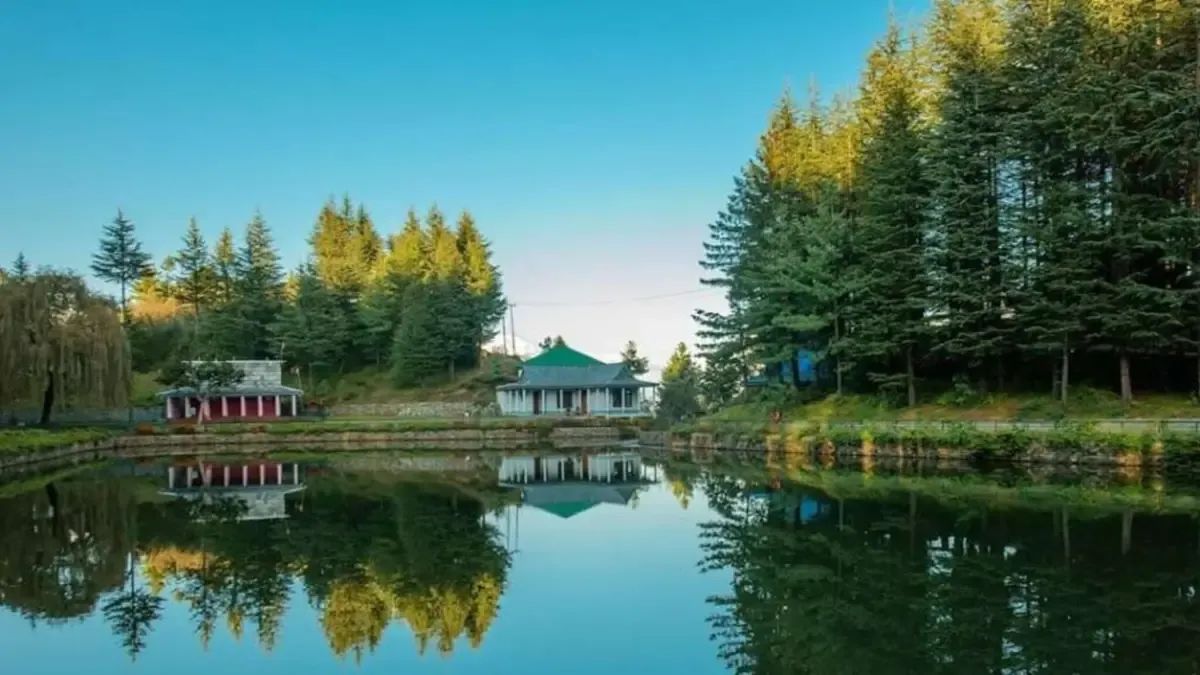
We meet you at Chandigarh or in Shimla and go straight through. Narkanda is 65km past Shimla on NH-5 at 2,708m, and the change is immediate — the built-up ridge stops and you are among deodar and orchard. Tani Jubbar in the afternoon, a small still lake about 6km out with a temple on the bank.
- Day 28km of single track each way
Hatu Peak, and the ridge
Early up the Hatu road, which turns off the highway and climbs 8km of tarred single track to just under the summit at 3,400m. There is a wooden temple at the top with a heavy slate roof, built in the local style, and on a clear morning you can see a very long way into Kinnaur. Afternoon on the ridge paths through the deodar, which almost nobody walks.
Show all 3 daysShow fewer days
- Day 340 min to Kotgarh, then back to Shimla or Chandigarh
Kotgarh, Thanedar and down
Down the far side into the apple country proper. Kotgarh and Thanedar are villages of orchards on a south-facing hillside above the Sutlej, with a nineteenth-century church, a few very old grafted trees, and the house Stokes built. Then back the way you came, or on down to Chandigarh for a flight.
The price
What is in it, and what is not
Included
- Private car and driver for all three days, fuel, tolls and parking
- Two nights at Narkanda or in an orchard homestay, twin sharing, with breakfast
- Pickup and drop at Chandigarh, Shimla or Kalka
- The driver's own food and accommodation
Not included
- Lunches and dinners
- Anything you buy at the orchards, which will be more than you planned
- Flights and trains
We do not publish a rate card. The number depends on the season, how many of you there are and the sort of hotels you want, so we price each trip on its own — and whatever we quote is what you pay.
Questions
What people ask about this one
When is the blossom, and when is the picking?
Blossom is late April into early May at this height and it lasts about a fortnight, which is why we will not promise you a date more than a season ahead. Picking runs from late August through September and into October depending on the variety and the year. They are the two reasons to come and they are six months apart, so decide which trip you are booking.
Can we start from Dharamshala instead?
Yes, and it adds two days — Dharamshala to Shimla is eight or nine hours and so is the way back, and neither is a day you would want either side of a three-day trip. Most people doing this route are coming up from Chandigarh or Delhi, or adding it to the end of a Shimla stay, and the itinerary is written that way for a reason.
What about the skiing we have read about?
Narkanda has one of the oldest ski slopes in India and it is not on this trip. It needs January and February, it needs a winter that has actually delivered snow, and in a poor year there is nothing on the hill at all — so it is not something to build three days and a flight around. This route runs in the two seasons the orchards make worth coming for. Ask us about the winter version separately and we will tell you honestly what is lying up there that week.
What is at Kotgarh, apart from apples?
Not a great deal, and that is the appeal. There is a stone church from the first half of the nineteenth century, a scattering of colonial-era houses, steep lanes between orchards, and views down to the Sutlej. It is a working farming district that happens to be beautiful, not a place that has been arranged for visitors, and there is nothing to queue for.
Does the Hatu road close?
It holds snow from about December to March and the top section closes when it does. The temple is still there and people still walk up. Outside those months the road is open, narrow and fine — it is 8km of single track with passing places and we would not drive it after dark.
Keep reading