
Shimla by the Kalka railway
Ninety-six kilometres of two-foot-six-inch track, 102 tunnels and most of a morning to climb 1,419m. You take the train up and we drive the luggage, then two days in the town it was built to reach.
- Kalka
- Barog
- Shimla
- Kufri
Good for — Anyone who would rather arrive than be driven, families with children, and railway people
Read the full descriptionClose the description
The Kalka–Shimla line was finished in 1903 to carry the government of India up a hill twice a year, and it has been listed by UNESCO since 2008. It is still the only way of arriving in Shimla that is better than the road.
This trip is built the obvious way round: you go up on the train, and we drive your luggage. That single arrangement is what turns a novelty ride into a sensible way to travel, and it is why the itinerary has a car in it at all.
What the line actually does
Ninety-six kilometres, on track two foot six inches apart, from 656m at Kalka to 2,075m at Shimla. That is 1,419m of climb.
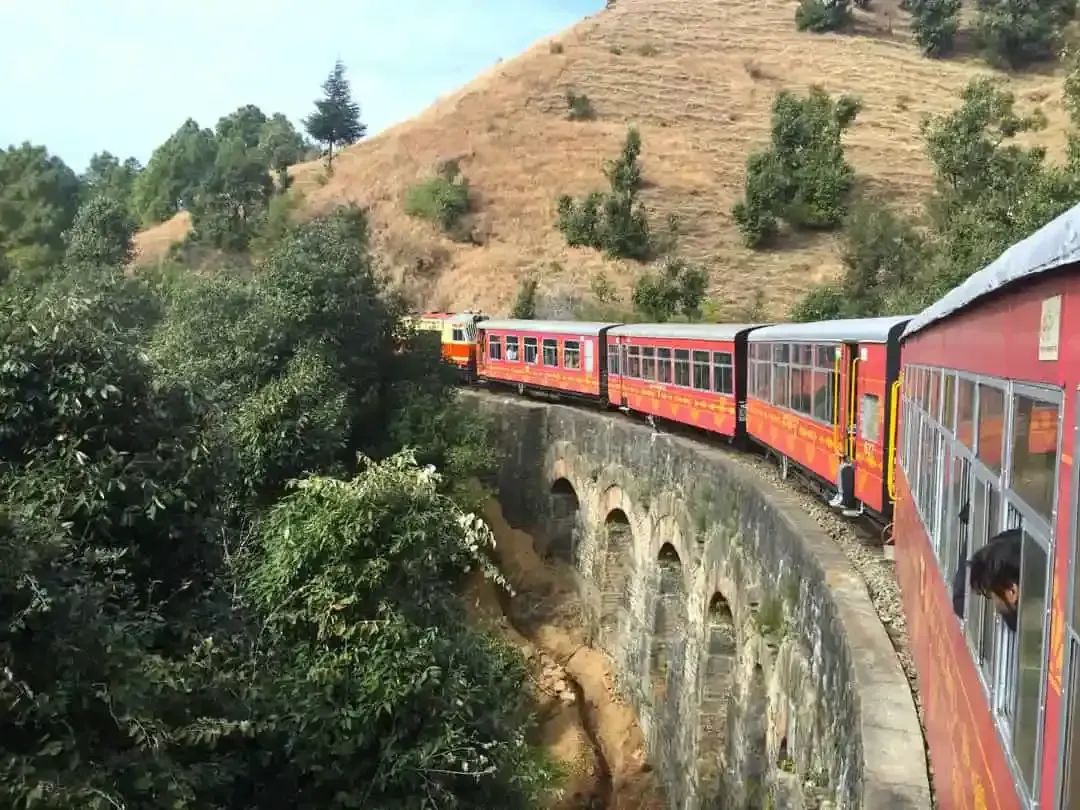
The engineering answer to that climb was not steep gradients — the line never exceeds about one in twenty-five — but distance and geometry. There are 102 tunnels still in use out of the 107 originally bored, close to a thousand bridges, and a great many of the bridges are multi-tiered stone arcades built like Roman aqueducts because that was cheaper in 1900 than steel.
Tunnel 33 at Barog is the long one at 1,143m and takes about two and a half minutes to pass through. The story attached to it — the engineer who bored from both ends, missed, was fined a rupee and shot himself — is told on every platform on the line and is worth hearing whether or not it is true.
The luggage is the whole trick
Every complaint about the toy train comes down to the same practical problem. Five to six hours in a narrow carriage is a pleasure; five to six hours in a narrow carriage with three suitcases is not, and Shimla station is above the town with a long walk or a queue for a porter at the other end.
So the driver takes your bags by road, which is three and a half to four hours, gets to Shimla first, checks you in, and meets your train. You carry a camera and a jacket.
It also means the day is recoverable. If the line is blocked, if the train is four hours late, if somebody decides after two hours that they have had enough of it — the car is on the parallel road and it is a phone call.
Where to sit, and when to look
The right-hand side going up, in the direction of travel, has the valley for most of the climb. Below Solan the left side gets the better of it briefly. Nobody sensible sits still for the whole run.
The stretch worth staying awake for is between Dharampur and Barog, where the line does most of its curving and you can see the front of your own train from the back. After Kandaghat it is more forest and less spectacle until Taradevi, and then Shimla appears stacked up its hillside about ten minutes before you get there.
What we would add with another night
Chail, an hour and a half out on the far side, and the reason is that it is the opposite of Shimla: a small hill station built by a maharaja who had been thrown out of this one, with a cricket ground at 2,444m and almost no traffic.
We run a longer trip that takes in Chail and Kasauli properly. If you have four days rather than three, that is the better shape and this one is not the trip to stretch.
Day by day
How the 3 days run
- Day 15–6 hrs on the train; the car takes 3.5–4
The train up
You board at Kalka at 656m and get off at Shimla at 2,075m, and everything in between is the point — 102 tunnels, close to a thousand bridges, and a gradient that never gets steep because the line simply goes round things instead. Barog is the lunch stop and tunnel 33 under it is the longest at 1,143m. Your driver takes the bags by road and meets you at the station.
- Day 2
Shimla on foot
The centre is closed to cars, which makes this the one Himachal town best seen without us. Christ Church and the Ridge, the Gaiety Theatre, the lanes of the lower bazaar where the town actually lives, and the climb to Jakhoo at 2,455m. The Viceregal Lodge in the afternoon — built for Lord Dufferin, and the room where the partition of India was argued over.
Show all 3 daysShow fewer days
- Day 316km to Kufri, then 3.5–4 hrs to Chandigarh
Kufri, and down
Out to Kufri in the morning for the ridge and the Himalayan Nature Park, which is the better half of it. Then down the Kalka road by car, with the option of picking up the train again at Solan or Kandaghat if you would rather have another hour of it.
The price
What is in it, and what is not
Included
- Reserved train seats, Kalka to Shimla, booked as far ahead as the railway allows
- Private car and driver for all three days, running alongside the train on day one
- Two nights in Shimla, twin sharing, with breakfast
- Pickup at Chandigarh airport or station, and drop wherever you finish
Not included
- Flights and long-distance trains into Kalka or Chandigarh
- Lunches and dinners
- Entry tickets at the Viceregal Lodge and the Nature Park
- Anything you buy for yourself
We do not publish a rate card. The number depends on the season, how many of you there are and the sort of hotels you want, so we price each trip on its own — and whatever we quote is what you pay.
Questions
What people ask about this one
Which train should we take?
There are several a day and they are not the same experience. The ordinary passenger trains are slower, stop everywhere and are how the line is actually used; the faster services have reserved chair cars and fewer halts. We will tell you which suits your morning and book accordingly — and we book early, because the good ones fill weeks ahead in season.
Is five hours on a small train too long with children?
It is the part children like most, in our experience — the windows open, the train is short enough to see both ends of on a curve, and something happens every few minutes. The thing to plan for is food and a lavatory stop rather than boredom. If it does go wrong, the car is on the road alongside and we can pick you up at Solan or Barog without any fuss.
Why not drive up and take the train down?
Because the views are better going up, and because the climb is the thing the line is famous for. It also puts the long sitting on the day you have just arrived rather than the day you are trying to get somewhere. If your flight times force the other way round we will do it, and it is still worth it.
Does it run in the monsoon and in winter?
It runs all year, and it is a working railway on a hillside — landslips in July and August and snow in January can suspend a service at a few hours' notice. That is the reason the car is on this itinerary rather than an extra. If the line is shut on your day we drive you up the same road it was built to replace and nobody is stranded.
Is Shimla worth two nights?
For most people, yes, and it is the one hill station where the walking is the attraction. What disappoints visitors is treating it as a sightseeing list — three points, a mall and a photograph. Two nights lets you do the Ridge in the evening when the residents come out, which is when the town makes sense.
Keep reading