
Destinations
Triund
A grass ridge at 2,828m with the Dhauladhar standing directly behind it and the Kangra valley three thousand metres below. Nine kilometres up from Dharamkot, and the most-walked path in the district.
Suits — first treks, one-night walks, photographers
Read the full descriptionClose the description
Triund is the walk everyone in Dharamshala is told to do, and the unusual thing is that it deserves the reputation. Nine kilometres and about 700m of climb puts you on an open grass ridge with a three-thousand-metre rock wall immediately behind you and the whole Kangra valley in front. There is nothing else this accessible with that view.
Being the walk everyone does has consequences. On a Saturday in April the path carries a lot of people, the tea shacks run out of things, and the top is crowded. Midweek it is a different walk. If you can choose your day, choose one.
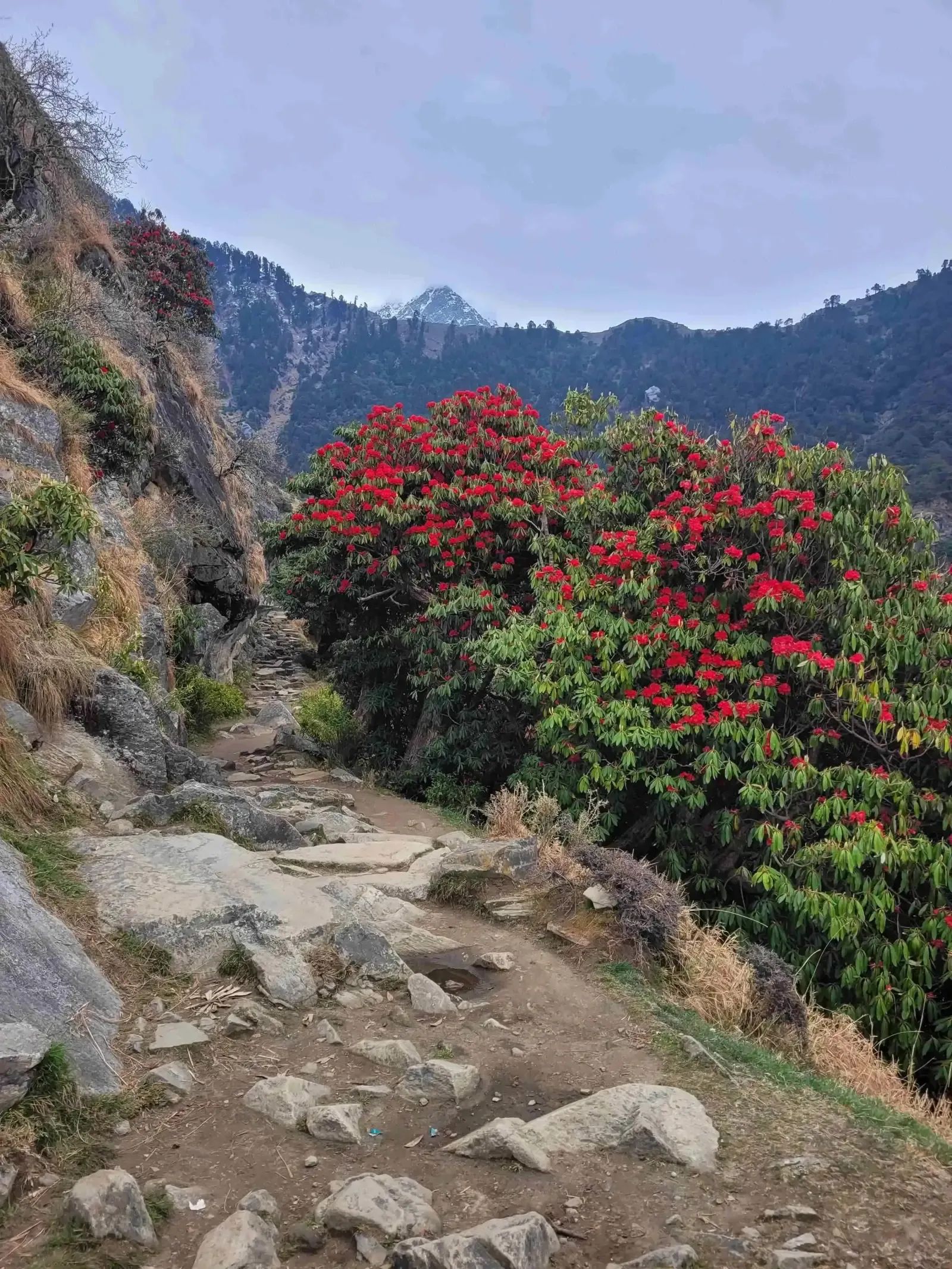
The climb is steady rather than steep for the first two thirds, through oak and rhododendron with shade most of the way. The last kilometre opens out and goes up in a series of switchbacks that everyone complains about. There is no scrambling and no exposure.
We drive you to Gallu Devi temple above Dharamkot, which removes the first and dullest hour. Take more water than you think, because the shacks are seasonal and unreliable, and take something warm — 2,828m in the evening is cold even when the valley was hot at lunchtime.
On staying overnight: the site has been under pressure for years and the rules on camping have changed more than once. Do not turn up with a tent assuming it will be fine. Ask us, or ask a licensed operator, close to the date.
- Altitude
- 2,828m at the top, about 2,130m at the start
- Distance
- 9km from Gallu Devi temple, one way
- Time
- 4–5 hours up, 3 down. Unhurried, with stops
- Difficulty
- Moderate. No technical ground, but a steady climb throughout
- We drive you to
- Gallu Devi, above Dharamkot. The walk starts there
- Best months
- March to June and September to November. Snow on the top section December to March.
Worth your time
What to actually go and see
The path
Rock and root through oak and rhododendron for most of it, then out onto open grass for the last kilometre. It is well trodden and hard to lose. The final stretch, known locally as the twenty-two curves, is the part people remember.
The top
A long grassy shoulder rather than a summit, so there is room to spread out. The Dhauladhar wall is immediately behind and Kangra is laid out below. On a clear evening you can see lights all the way to the plains.
Snowline and Laka Got
Two kilometres further and about 400m higher, at the edge of the permanent snow. A couple of seasonal tea shacks. Most people who stay the night walk up here in the morning.
Rhododendron in spring
The oak forest on the lower half fills with red rhododendron in March and April, which is the best few weeks to do this walk and also the busiest.
Staying the night
Camping at the top has been restricted since the site was being damaged by the numbers, and what is permitted changes. Assume you need to arrange it through a licensed operator, and check the current position before planning a night.
The Triund ridge, photographed
4 photographs.


Keep reading