
Triund, and a night on the ridge
Nine kilometres up from Gallu Devi to a grass shoulder at 2,828m with the Dhauladhar wall directly behind it, a night under canvas, and down the next morning. The one walk we would put almost anybody on.
- Gallu Devi
- Triund
- Laka Got
- Dharamkot
Good for — A first Himalayan walk, reasonably fit people of any age, and anyone with two spare days
Read the full descriptionClose the description
Every trip we sell out of Dharamshala is done from a car. This one is not, and it is the reason it exists: the Dhauladhar is directly above the town, it is one of the steepest rises anywhere in the Himalaya, and you can be standing on the shoulder of it in an afternoon.
Two days, one of them half a day. It fits into almost any other itinerary we run.
What the walk is actually like
Nine kilometres, about 700m of ascent from Gallu Devi at 2,130m, four to five hours going up at a pace where you can talk.
The first two thirds is forest — oak, then rhododendron, on a rock-and-root path that is worn deep in places from a century of use. It is shaded, which matters in May. Somewhere around the two-thirds mark the trees stop and you come out onto open ground for the last long traverse, and that is where people start taking photographs and stop talking.
There are tea stalls on the way up. They are part of the walk rather than an intrusion on it, and the one at Magic View is where everyone stops whether they planned to or not.
The top is a shoulder, not a summit
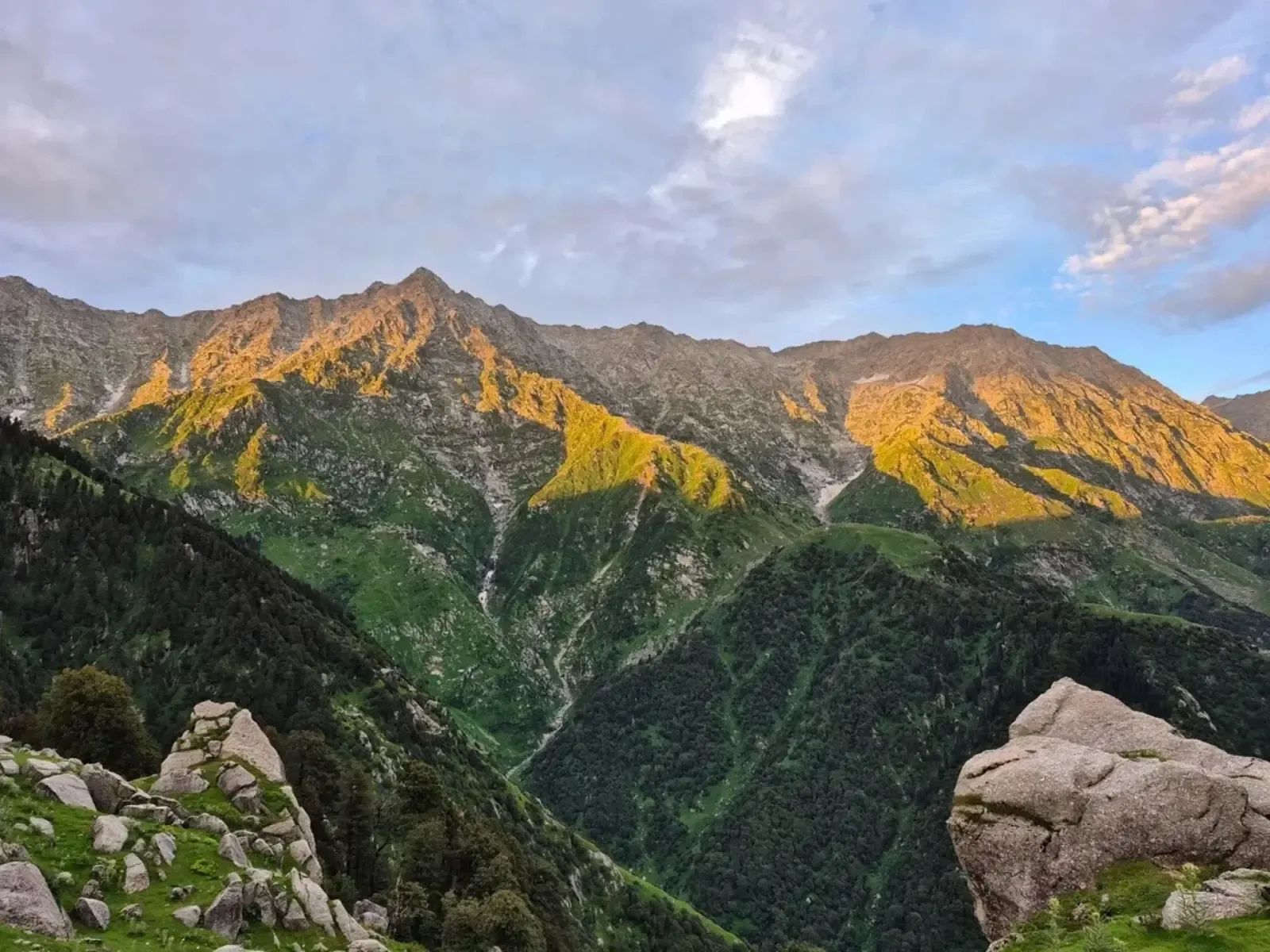
Triund is a long grass ridge with room on it, which is why it works for a night. Behind you the Dhauladhar goes up in one unbroken wall — Moon Peak and the Indrahar notch are the ones people ask about — and in front the ground falls away into the whole Kangra valley.
At dusk the valley fills with light and then with haze and then with cloud, and the lights of Dharamshala, Palampur and half a dozen villages come on underneath it. That is what you are paying for. It is worth getting the timing right, which is the whole argument for walking up in the afternoon rather than the morning.
What we bring, and what you bring
We bring the tent, the mats, the sleeping bags, the food and the guide. Dinner is cooked on the ridge and it is dal, rice and something else, and everybody eats all of it.
You bring boots with grip, more layers than the afternoon suggests you will need, a head torch and two litres of water. The temperature drop after sunset at 2,828m is the thing every first-timer underestimates: it can be shirtsleeves at five and close to freezing by nine in March or October.
Phone signal is patchy and there is no power. Take a battery pack if the camera matters to you.
Where this sits among the other walks
Triund is the short one, and it is the one that has ruined a lot of people for beach holidays.
Above it the same ridge line carries on to Laka Got, to Moon Peak and eventually over Indrahar Pass into Chamba, and those are serious multi-day undertakings that need a different level of fitness, a different amount of kit and a weather window. Kareri Lake, on the other side of Dharamshala, is the other obvious next step and is a gentler two nights.
If you find yourself on the ridge at six in the evening thinking you would like to carry on tomorrow, tell the guide. We can usually make it happen with a day’s notice, and we would rather build the trip you have discovered you want than the one you booked.
Day by day
How the 2 days run
- Day 130 min to the trailhead
Gallu Devi, and up
We collect you after breakfast and drive to Gallu Devi above Dharamkot at 2,130m, which takes the first hour of climbing out of the day. The walk is about 9km and four to five hours unhurried, through oak and rhododendron for most of it and then out onto open ground for the last hour. Tea at Magic View halfway. You are on the ridge in the middle of the afternoon with time to spare before the light goes.
- Day 2
Sunrise, then down
Up early whether you meant to be or not — the sun comes onto the Dhauladhar before it reaches the camp and the whole Kangra valley is under cloud below you. Breakfast, then three hours down the same path, which is harder on the knees than it was on the lungs. Back in Dharamshala by lunch.
The price
What is in it, and what is not
Included
- Car to Gallu Devi and back from the trailhead
- A guide who has done this walk a great many times
- One night in a tent, twin sharing, with sleeping bag and mat
- Dinner, breakfast and tea on the ridge
- The forest department's camping permission, arranged before the day
Not included
- Lunch on either day, and anything bought at the stalls on the path
- Porters, if you would rather not carry your own daypack
- Personal walking kit — boots, layers, a torch
- Anything you buy for yourself
We do not publish a rate card. The number depends on the season, how many of you there are and the sort of hotels you want, so we price each trip on its own — and whatever we quote is what you pay.
Questions
What people ask about this one
How fit do I need to be?
Fit enough to walk uphill for four hours with stops. There is no technical ground, no exposure and no scrambling — it is a well-made path the whole way, and children of ten and people in their sixties do it regularly. What catches people out is the descent, which is steady, stony and unrelenting on the knees. If yours are bad, bring poles and tell us so we allow more time.
Why not do it as a day walk?
You can, and a lot of people do, and they miss the reason to go. Triund in the middle of the day is a crowded picnic spot with tea stalls; Triund at six in the evening, after the day-trippers have gone down, is a quiet grass ridge with a four-thousand-metre wall behind it. The night is the trip. The walk is how you get to it.
Can we sleep in one of the shops or huts?
Camping on the ridge has been restricted since the site was being damaged by the numbers, so what is allowed and where it is allowed changes. We arrange the permission before the day and we camp where we are permitted to, which is sometimes not where the photographs on the internet were taken. If nothing can be arranged for your dates we will say so before you travel rather than after.
What about Laka Got and the snowline?
Two kilometres further and about 400m higher, at the edge of the permanent snow. It is an easy extra hour from the ridge and we will do it on the first afternoon if the party is going well and the weather is settled. It is not on the itinerary because deciding it in advance is the wrong way round.
When should we not come?
July and August. The path is a stream, the ridge is inside cloud, and the thing you climbed for is not visible. Late March and April for the rhododendron — which is also the busiest few weeks — and October for the clearest air. December to February is doable in settled weather with proper kit and we treat it as a different proposition, so ask rather than book.
Keep reading