
Destinations
Kangra valley
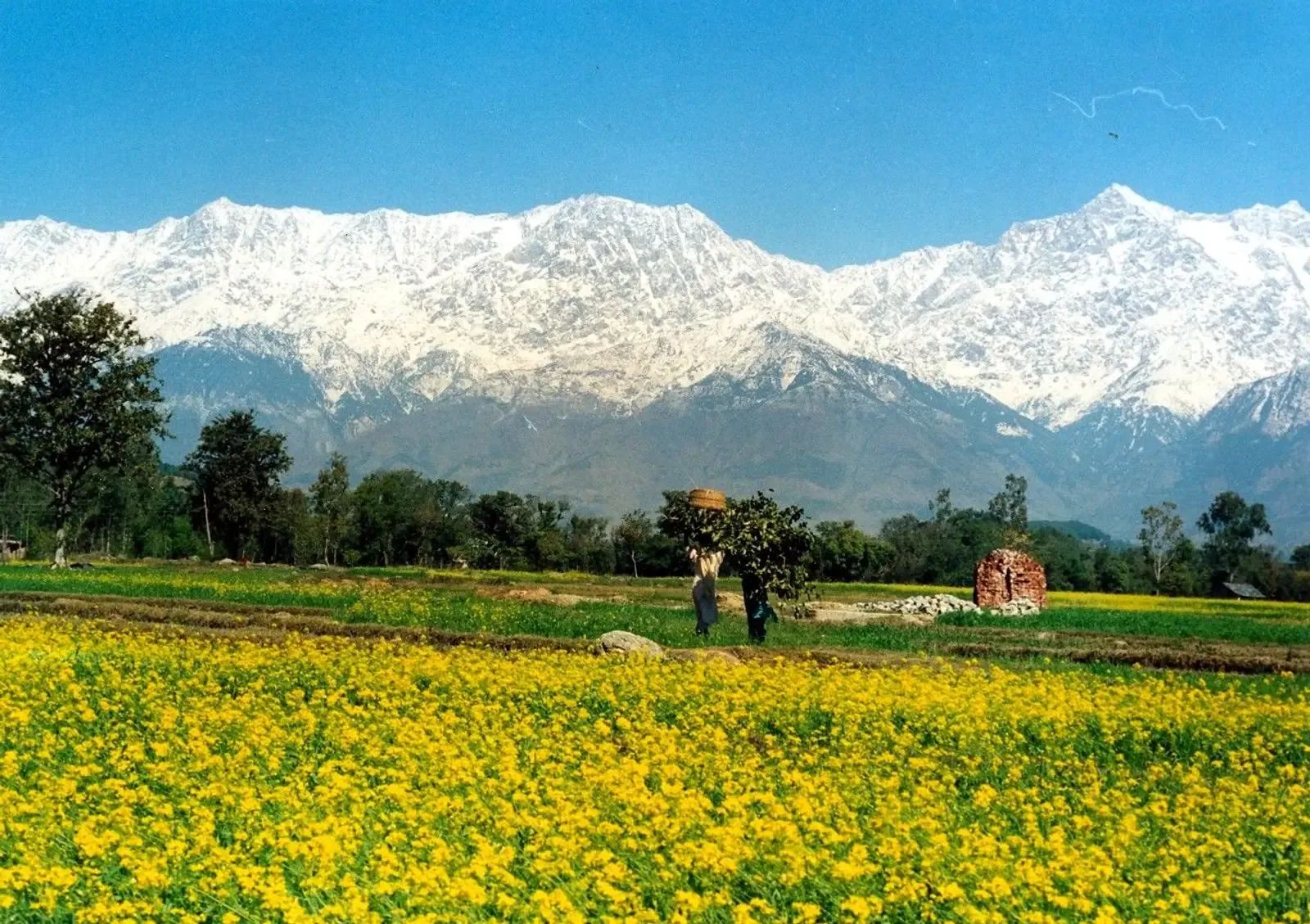
The wide farmed valley under the Dhauladhar, and the older half of this district. A fort the Katochs held for centuries, rock-cut temples from the eighth century, and the school of painting the valley gave its name to.
Suits — history, temples, architecture, slow driving
Read the full descriptionClose the description
Most people treat Kangra as the place the airport is, and drive straight up to McLeod Ganj. The valley below is where the district’s history actually happened.
Kangra fort sits on a spur where the Manjhi and Banganga meet, and it was held by one family, the Katochs, for an extraordinarily long time. It was also attacked by almost everybody: Mahmud of Ghazni stripped the treasury in 1009, Jahangir took it in 1620, the Sikhs held it in the nineteenth century. What finished it was not a siege but the earthquake of 4 April 1905, which killed around twenty thousand people across this valley and brought down most of what was standing.
That earthquake is the thread running through everything here. It is why Brajeshwari Devi is a modern building on an ancient site, why the fort is a ruin, and why Baijnath — which came through it — is worth the detour.
Masroor is the one to make time for. Fifteen temples carved out of one outcrop of sandstone in the eighth century, facing the Dhauladhar across a tank. It is the only rock-cut complex of its kind in the north of India, it is forty kilometres from the fort on small roads, and on most days there is nobody there.
The valley floor is hot from May onwards and genuinely unpleasant in June. This is a winter and spring trip, which is the opposite of the rest of Himachal.
- Altitude
- About 730m at Kangra town
- From Dharamshala
- 18km, roughly 45 minutes
- Nearest airport
- Gaggal, 7km from Kangra town
- The narrow-gauge line
- Pathankot to Joginder Nagar, 164km, running since 1929
- Give it
- A full day. Two if Masroor and Baijnath are both on the list
- Best months
- October to April. The valley floor is hot from May, and the monsoon here is heavy.
Worth your time
What to actually go and see
Kangra fort
Held by the Katoch dynasty, one of the oldest surviving forts in India, and taken by more or less everyone who tried — Mahmud of Ghazni, Jahangir, the Sikhs. Badly damaged by the 1905 earthquake, and what remains is a long sequence of gateways climbing a spur above two rivers.
Masroor rock temples
Fifteen temples cut from a single ridge of sandstone in the eighth century, in the same tradition as Ellora and almost unvisited. The 1905 earthquake took the tops off several of them. About 40km from Kangra town.
Brajeshwari Devi
One of the principal shakti peeths, and rich enough historically that it was looted repeatedly. The present building is twentieth century — the earthquake destroyed what stood before — and it is busy with pilgrims all year.
Baijnath
A Shiva temple of 1204 in dressed stone, on the road towards Palampur, and remarkable mainly because it came through 1905 essentially intact when almost nothing else did.
Kangra painting
The Pahari miniature school that flourished here in the late eighteenth century under Sansar Chand — fine line, Krishna themes, and landscape that is recognisably this valley. Best seen at the museum in Dharamshala.
Keep reading