
Norbulingka and the Tibetan Kangra
Seven exile institutions strung along forty kilometres of the Kangra valley — a craft school where thangka painters train for six years, two monastic colleges, a Khampa village. Three days of the thing Dharamshala is actually known for.
- Norbulingka
- Gyuto
- Tashi Jong
- Sherabling
- Bir
Good for — Anyone interested in Tibetan art, craft or Buddhism, and second trips to Dharamshala
Read the full descriptionClose the description
Dharamshala is known for one thing and most visitors see the smallest version of it. The Dalai Lama’s temple at the top of the hill takes a morning, and then people go and look at a waterfall.
What is actually here is a network of institutions rebuilt from scratch after 1959, spread down the valley from Sidhpur to Bir, most of which are open, none of which is on a coach route, and several of which are doing work of a standard you would go a long way to see.
Why the trip goes downhill from McLeod Ganj
The exile community is not concentrated on the ridge. It never was.
McLeod Ganj holds the administration, the temple and the market, because that is where land was available in 1960. The workshops, the colleges and the big monasteries went where there was room and water — Sidhpur, Sidhbari, Taragarh, Bhattu, Bir — and that is a forty-kilometre string along the foot of the Dhauladhar rather than a hill station.
So this trip drives down and along. It is the opposite direction from every other Dharamshala itinerary, including our own day tour, and it is why almost nobody does it.
Norbulingka, and what a craft institute is for
Founded in 1988 by Kelsang and Kim Yeshi and opened to visitors in 1995, named for the Dalai Lamas’ summer palace outside Lhasa.
The purpose is narrower and more interesting than “preserving culture”. Tibetan statue making, thangka painting, appliqué and woodcarving are trades with apprenticeships, and in 1959 the chain of transmission for all of them was broken. Norbulingka exists to run those apprenticeships — six years for a thangka painter — so that the skills have somewhere to be passed down.
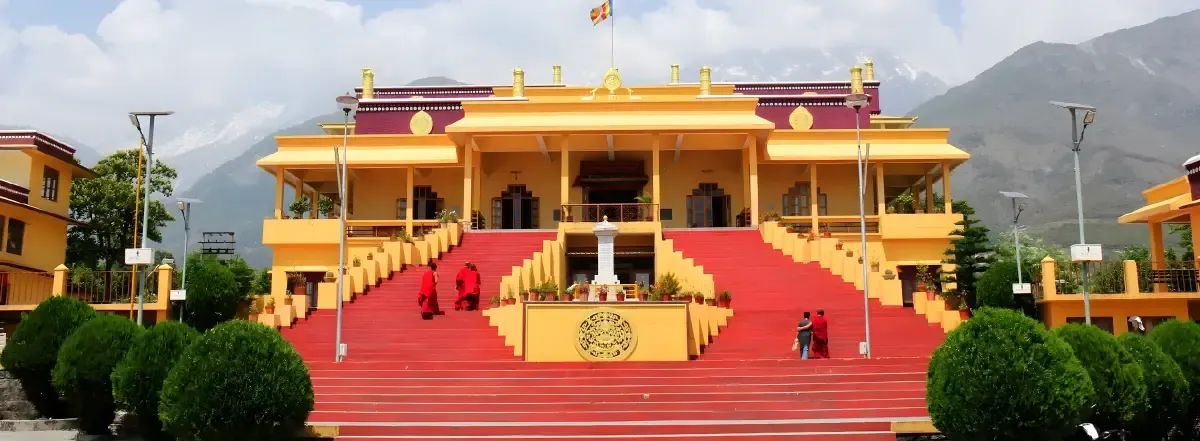
You can watch it happening. A painter grinding mineral pigment, a metalworker raising a face out of sheet copper, a room of people cutting silk for appliqué. The temple at the top of the garden holds a four-metre gilded Sakyamuni and 1,173 painted Buddhas, and it was built by the people you have just watched working.
Sherabling is the one nobody has heard of
Eight kilometres up a side road from Baijnath, in pine forest, and the seat of the 12th Kenting Tai Situpa.
It is a Kagyu establishment with a monastic college, a library and a very large main shrine hall, and the thing that strikes everyone is how quiet it is compared with anywhere on the ridge. There is no market outside it, no ticket, and often nobody in the courtyard at all. The forest comes right up to the walls.
Tashi Jong, half an hour before it, is the opposite kind of place: not a monastery with a village attached but a Khampa community with a monastery in the middle of it, still making things — thangkas, metalwork, textiles — and still recognisably a settlement of people from a particular part of eastern Tibet.
What to do with your hands and your feet
Two practical notes that make the difference between visiting and intruding.
Walk clockwise around anything — stupas, temples, prayer wheel rows. It is the convention everywhere on this itinerary and getting it wrong is the one thing that will make somebody visibly wince.
Do not point your feet at an image or a person, which mostly means being careful how you sit down in a hall. Sit cross-legged or kneel; nobody minds a bad job of it. And if you arrive at Gyuto while the hall is chanting, stand at the back and stay there — the low multiphonic sound the Gyuto monks are known for is a liturgy rather than a recital, it does not stop for an audience, and the worst thing you can do to it is walk about looking for an angle.
Day by day
How the 3 days run
- Day 130–40 min from McLeod Ganj
Sidhpur and Sidhbari
Down out of McLeod Ganj rather than around it. Norbulingka at Sidhpur is a working craft institute — statue makers, thangka painters, appliqué, woodcarving and a papermaking room — set in a Japanese-designed garden, with a temple at the top of it holding a four-metre gilded Sakyamuni and 1,173 painted Buddhas on the walls. Gyuto at Sidhbari in the afternoon, a tantric college whose monks are known the world over for their chanting.
- Day 290 min, in short hops
Tashi Jong and Sherabling
East along the foot of the Dhauladhar. Tashi Jong at Taragarh is a Khampa community as much as a monastery — a village with a craft workshop, a thangka school and a monastery in the middle of it. Palpung Sherabling, 8km up a side road from Baijnath, is the quietest place on this itinerary: the seat of the 12th Tai Situpa, deep in pine forest, with a college and a library. A night at Bir.
Show all 3 daysShow fewer days
- Day 32 hrs home
The Bir gompas, and back
Bir's Tibetan colony was settled in the 1960s and has three monasteries of different schools inside a couple of kilometres — Chokling with its stupa, Dzongsar's college, and the Deer Park institute, which runs public teaching and is the one place on this trip you can simply sit in on something. Home in the afternoon.
The price
What is in it, and what is not
Included
- Private car and driver for all three days, fuel, tolls and parking
- Two nights twin sharing with breakfast, one near Dharamshala and one at Bir
- Arranging the Norbulingka workshop visits before the day
- Pickup and drop anywhere in Dharamshala or McLeod Ganj
Not included
- Lunches and dinners
- Donations at the monasteries
- Course and workshop fees, if you want to make something rather than watch
- Anything you buy for yourself
We do not publish a rate card. The number depends on the season, how many of you there are and the sort of hotels you want, so we price each trip on its own — and whatever we quote is what you pay.
Questions
What people ask about this one
How is this different from the McLeod Ganj day tour?
That day stays on the ridge — the Dalai Lama's temple, Bhagsu, the market, Naddi at sunset — and it is the right first day for anyone. This one goes down into the valley and out along it, to places that have no day-tripper traffic at all: a craft institute, two monastic colleges and a Khampa village. Tsuglagkhang is not on this itinerary, because most people booking it have already been.
Can we watch the craftspeople working?
At Norbulingka, yes, and that is the point of going. The studios are open to visitors on working days and you can stand in the statue workshop and the thangka room and watch people at extremely slow, extremely skilled work. It shuts for Tibetan holidays and for Losar, and we check the calendar before we put it on your day.
Are we allowed inside the monasteries?
Into the temple halls, generally yes, quietly and with your shoes off. Into the colleges, the retreat quarters and the private areas, no. Photography is allowed in some halls and not in others and the rule is posted; where it is not, ask rather than assume. Nothing here is a museum and everywhere is somebody's home or place of work.
Will we meet a teacher?
Sometimes, and we do not promise it. Deer Park at Bir runs a public programme and if a course is on during your dates anyone may attend, which is by far the most likely way it happens. The senior teachers travel a great deal and their diaries are not ours to arrange. We will tell you what is scheduled and leave the rest to chance.
Is three days enough?
For the buildings, yes. For the crafts, no — Norbulingka runs short courses in thangka painting and woodcarving that take days rather than hours, and people who came for an afternoon regularly stay a fortnight. If that is a risk you would like to take, tell us at the enquiry and we will put you in touch directly instead of building it into a tour.
Keep reading