
Chamba and the Manimahesh yatra
The old Chamba town first, then up the Ravi to Bharmour and the walk from Hadsar to a lake at 4,080m under a peak nobody has climbed. A pilgrimage that is still mostly pilgrims.
- Chamba
- Bharmour
- Hadsar
- Dhancho
- Manimahesh
Good for — Pilgrims, walkers with a head for altitude, and anyone who wants a Himalayan crowd rather than a Himalayan queue
Read the full descriptionClose the description
This is the only trip on the site built around a date somebody else sets. The Manimahesh yatra happens when the calendar says it does, in Bhadon, and for those few weeks a valley that sees very little traffic carries tens of thousands of people on foot up to a lake at four thousand metres.
It is worth understanding what you are joining. This is not a trek with a religious backdrop. It is a pilgrimage that you are welcome on, and the difference shows in everything from who is on the path to what time the day starts.
Chamba first, and not only for the acclimatisation
Two nights before the walk starts is what makes it survivable — one at Chamba at 996m and one at Bharmour at about 2,200m — and Chamba would earn its night anyway.
The town is arranged around the Chaugan, a long strip of grass that everything faces, and the Lakshmi Narayan complex behind it is six stone temples in one walled courtyard with the oldest from the tenth century. The Bhuri Singh Museum opened in 1908 and holds the Chamba and Basohli miniature paintings, which are the reason art historians come to this valley at all.
Then Bharmour, three hours further up a road that narrows the whole way, where the Chaurasi compound holds eighty-four shrines around one courtyard and where the yatra is formally registered. You sleep at about 2,200m. That night is doing more work for you than anything else on the itinerary.
What the walk asks of you
Roughly 13km from Hadsar and about 1,900m of climb, split over two days, finishing at 4,080m.
The first stage to Dhancho is the forgiving one — a few hours beside the nallah, mostly moderate, with the waterfall at the end of it. The second is not. It climbs steeply out of Dhancho and then keeps going across open ground with nothing to hide behind, and it is done in the dark for the first hour or two because everyone wants to be at the lake in the morning light.
Altitude is what stops people, not the gradient. Above Dhancho you are gaining height faster than a body acclimatises, and a headache that is manageable at three thousand metres is not at four. Drink far more than you want to, walk more slowly than feels sensible, and tell the guide early rather than late.
The lake, and the peak behind it
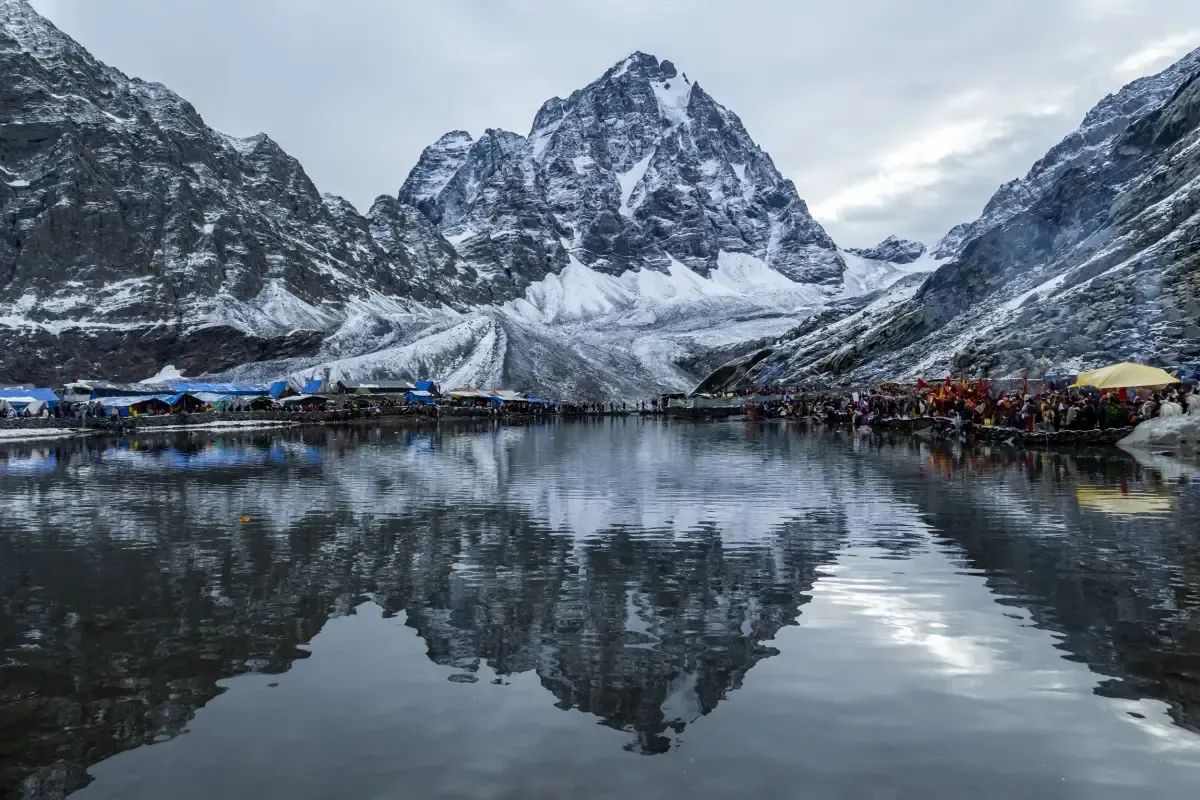
Manimahesh is not large and the setting is what makes it. Manimahesh Kailash stands at 5,653m directly across the water and has never been climbed — the attempts stopped because the mountain is held to be a residence of Shiva and the community has asked that they do.
In the yatra weeks the shore is lined with tarpaulin shelters and there are thousands of people at the water before dawn. Whether that is the attraction or the problem is the single question to answer before booking, and we would rather you answered it honestly. If a crowd at a holy place is what you have come for, there are very few of them left in the Himalaya that are still like this. If you want an empty lake, come in late September after the yatra ends and we will build that instead.
Cold, and what to carry
It can snow at the lake in September. The temperature at four in the morning on the upper stage is close to freezing and there is nowhere sheltered on it.
Bring a proper insulated layer, a windproof shell, gloves and a hat, and wear boots rather than the trainers half the path is walked in. Carry your own water and a torch. The shelters on the route sell tea and food and are not somewhere to plan on sleeping.
Everything else — tent, bedding, meals on the trek — we bring.
Day by day
How the 5 days run
- Day 1190km, 6–7 hrs
Dharamshala to Chamba
Out through Nurpur and up the Ravi. Chamba is a town of about a thousand years arranged around a grass maidan, and the afternoon is for the Lakshmi Narayan temples — six of them in one courtyard, the oldest tenth century — and the Bhuri Singh Museum, which holds the Chamba and Basohli miniatures and is very much better than it needs to be.
- Day 265km, 3 hrs on a narrow road
Up to Bharmour
The Ravi gorge to Bharmour, which was Chamba's capital before Chamba was. The Chaurasi compound at the middle of it holds eighty-four shrines around one courtyard and is where the yatra is registered and blessed. An afternoon and a night here at about 2,200m, which is the acclimatisation and is not optional.
Show all 5 daysShow fewer days
- Day 3Half an hour to the roadhead, then about 6km on foot
Bharmour to Hadsar, and up to Dhancho
A short drive up the valley to Hadsar, where the road ends and the walk begins. Dhancho is the usual first stop, a few hours up beside the Manimahesh nallah with the waterfall at the top of the stage. Tented camp for the night. It is short on purpose — the point of today is height gained slowly, not distance covered.
- Day 4Half an hour from Hadsar, once you are off the hill
The lake, and back down
Out before first light for the steep half. Gauri Kund is about a mile short of the top and is where women bathe; the lake itself sits at 4,080m with Manimahesh Kailash, 5,653m and unclimbed, standing straight out of the far shore. It is a long day on your feet — most people are down at Hadsar by evening, and the car takes you the last stretch back to Bharmour for a bed, a shower and a second night at the same altitude you acclimatised at.
- Day 59–10 hrs, and we would rather break it
Bharmour to Dharamshala
Three hours down the Ravi to Chamba, then six or seven more to Dharamshala. That is a great deal to ask of anybody the day after a four-thousand-metre walk, so the honest suggestion is to break it at Dalhousie — it adds a night and takes four hours off this day. We will say so when you book rather than at eight in the morning on day five.
The price
What is in it, and what is not
Included
- Private car and driver for all five days, fuel, tolls and parking
- Three nights in hotels, one at Chamba and two at Bharmour, twin sharing, with breakfast
- A tented night on the yatra route, with meals
- A guide for the walk from Hadsar
- Help with the yatra registration at Bharmour
Not included
- Lunches and dinners off the trek
- Ponies and porters, which are hired at Hadsar and are worth it
- Helicopter tickets, if you would rather fly the trek
- Temple offerings, and anything you buy for yourself
We do not publish a rate card. The number depends on the season, how many of you there are and the sort of hotels you want, so we price each trip on its own — and whatever we quote is what you pay.
Questions
What people ask about this one
When exactly does the yatra happen?
It runs in the Hindu month of Bhadon, which falls in August or September, and the main days are from Janmashtami to Radhashtami. The exact dates move every year with the calendar and the state announces them, so ask us rather than assuming — we plan the trip around the announcement, not around a guessed week.
Can we walk it outside the yatra?
Yes, and it is a completely different experience. Late June to early October the path is open and largely empty, there is no infrastructure on it, and you are camping properly rather than sleeping in a pilgrimage camp. Quieter, harder, and you carry more. Tell us which one you want, because they are not the same trip with different dates.
How hard is the walk?
About 13km from Hadsar with roughly 1,900m of climbing, which is a great deal in two days, and the top is at 4,080m where there is a third less oxygen than at home. It is not technical. It is high, steep and cold at the top, and the most common reason people turn back is altitude rather than fitness. The night at Bharmour and the short first day are both there to reduce that.
Can we take ponies?
Yes. They are hired at Hadsar, they are the normal way for older pilgrims to travel, and the rate is set locally and is posted. A pony does not remove the altitude and you will still be at 4,080m — it removes the effort of getting there, which for a lot of people is the difference between arriving and not.
Is the helicopter worth it?
It runs in the season between Bharmour and Gauri Kund, it is weather-dependent, and it books out. It also takes you from about 2,200m to within a mile of a 4,080m lake in fifteen minutes, with no acclimatisation at all, which is the single worst thing you can do to yourself on this route. Everything else on this itinerary — the Chamba night, the Bharmour night, the short first stage to Dhancho — exists to stop that happening. We will book it for someone who cannot walk. We would not choose it.
Keep reading