
Himachal in a fortnight
The one trip that joins the two halves of the state — Kangra and Shimla, then up the Sutlej into Kinnaur, across Spiti and out over Kunzum into Lahaul. Fourteen days, one car, and the only sane way to acclimatise for it.
- Dharamshala
- Shimla
- Kinnaur
- Spiti
- Manali
Good for — A once-in-a-decade trip, sabbaticals, and anyone who has flown a long way to get here
Read the full descriptionClose the description
Most people who write to us with two weeks want to know whether they can fit everything in. The answer is that Himachal has two halves that do not join conveniently, and a fortnight is the length at which joining them stops being a forced march and becomes the best trip in the state.
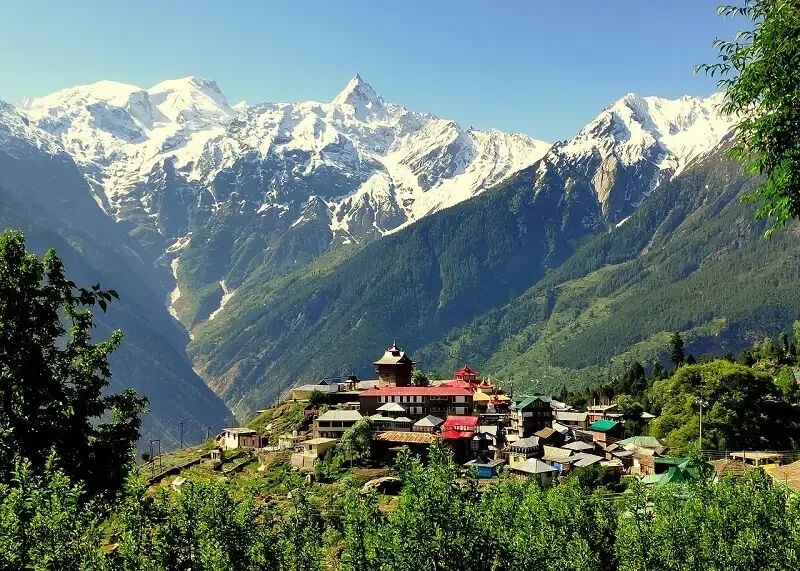
This is that trip. It starts in the Kangra valley at fifteen hundred metres and finishes in Manali, and in between it crosses from the wet, green, forested western end of Himachal to the high desert on the Tibetan side of the main range, entirely by road.
The one thing this itinerary is actually built around
Not the sights. The rate of ascent.
Kaza is at 3,650m and you cross Kunzum La at 4,551m to leave it. Your body needs days at intermediate heights to make the red cells that make those numbers comfortable, and there is no substitute for time — no drug, no fitness, no amount of wanting it.
So the sequence is Shimla at about 2,200m, Sarahan, Sangla at 2,700m, Kalpa at 2,960m, Nako, Tabo, then Kaza. Each night is a modest step on the one before, and by the time you reach 3,650m you have been working up to it for the better part of a week.
The alternative, which half the operators in the state sell, is to drive in from Manali: 2,050m to 3,650m over one pass in about thirty hours. It works for some people. The ones it does not work for spend two days of a nine-day trip lying down.
What the fortnight buys that nine days does not
Our Spiti route is nine days and it is the same country. What it is not is the same trip.
Nine days starts at Dharamshala and drives, and every day has a destination. The fortnight has four days in it with nothing much scheduled — the second Kangra day, the Shimla day, the Kalpa afternoon, the second day at Kaza — and those are the days people describe afterwards.
It also fits two whole regions in that the shorter route has to skip: the Baspa valley, which Spiti never sees, and the Kangra start, which is where you get over the flight.
Fourteen days in one car, honestly
You will be in the same vehicle with the same driver for a fortnight, and that is worth thinking about before you book rather than on day nine.
The driving is real: three days over seven hours, four over five, and the Batal stretch between Chandratal and Gramphu is not a road so much as a route across a riverbed. Nobody should be doing this in a hurry and nobody should be doing it with a schedule that has no give in it.
What makes it work is that the driver is the same person throughout. He knows by day four who gets carsick, who wants to stop for photographs, who needs the window shut. That continuity is most of what a private car is for on a trip this length, and it is why we do not hand you over at Shimla to somebody else’s vehicle the way a cheaper version of this would.
When we would tell you to come, and when not
June, and then again from the start of September to the middle of October. Those are the windows when the Sutlej road, Kunzum and the Batal stretch are all reliably open at the same time and the weather is settled at both ends.
July and August are the exception we make for Spiti and do not make for this. Spiti itself is a rain shadow and is dry and open through both; the problem is that this route spends five of its fourteen days on the outer ranges, which is exactly where the monsoon concentrates. The Sutlej gorge takes rockfall, the Mandi–Pandoh stretch is the least reliable road in the state, and a fortnight that loses two days to a blocked hillside stops being the trip you booked. If those are the only weeks you have, take our nine-day Spiti route instead — it is a shorter thing to reschedule.
Late October is possible and gets steadily less so. Kunzum closes with the first serious snow and after that there is no way out to the west, which turns the itinerary into an eighteen-hundred-kilometre retreat back down the Sutlej. We would rather move your dates.
Day by day
How the 14 days run
- Days 1–2Airport transfer, then local
Kangra, to start low
We meet you wherever you land and take you up to Dharamshala. Two days here before anything else: McLeod Ganj and the temple, the tea gardens at Palampur, Naddi for the Dhauladhar at sunset. Nothing about these two days is high, hard or far, and that is deliberate — most people arrive off a long flight.
- Day 38–9 hrs
Across to Shimla
The longest transfer of the fortnight and the only really dull one. Down through Una and Bilaspur, up into the Shivaliks. In by late afternoon with a walk on the Ridge if you want one.
Show all 14 daysShow fewer days
- Day 4
Shimla
The old summer capital on foot, which is the only sensible way to see it. Christ Church, the Viceregal Lodge and the lower bazaar, and Jakhoo if the legs are willing. A short day before a week of long ones.
- Days 5–65–6 hrs, then 4–5
Up the Sutlej into Kinnaur
Out past the orchards at Narkanda and down onto the Sutlej at Rampur. A night at Sarahan for the Bhimakali temple, then the turn up the Baspa at Karcham into a valley that is nothing like the gorge you have just left. A night at Sangla at 2,700m.
- Day 724km up the valley, then 46km across
Chitkul, and on to Kalpa
Up to Chitkul at 3,450m in the morning — the last village anybody lives in on this side — and back down to cross to Kalpa in the afternoon. Kalpa sits at 2,960m on an orchard shelf under the Kinner Kailash wall. Second night above 2,700m, which is the point of the sequence.
- Days 8–9105km, then 62km
Nako, Tabo and the inner line
Reckong Peo for the inner line permit, then the gorge road above Pooh — the most exposed driving on the trip and the reason people come. A night at Nako, a night at Tabo and its thousand-year-old mud-walled monastery. You are in Spiti now and you got here by gaining about a thousand metres over five days.
- Days 10–1147km, then local
Kaza, and the villages above it
Dhankar on its spur on the way through, then Kaza at 3,650m. A full day for Key and Kibber and the road up to Komic, Langza and Hikkim, which is as high as anyone drives in this country. Take the second day slowly whatever you feel like on the first.
- Day 124–5 hrs on the worst surface of the trip
Over Kunzum, and Chandratal
Kunzum La at 4,551m and down into the Chandra valley. Chandratal is a couple of kilometres off the road and you walk the last of it. A night at the camps below the lake, which are basic and cold and worth it.
- Day 136–7 hrs, and the tunnel at the end of it
Down the Chandra to Manali
The Batal road, which is a riverbed with ambitions, then Gramphu, Sissu and through the Atal Tunnel. Nine kilometres of it and you come out in a valley with trees in it for the first time in a week. Manali for the night, and a hot shower everybody will have earned.
- Day 148 hrs to Dharamshala, or 4 to Bhuntar
Home
Back round the end of the Dhauladhar to Dharamshala, or a short run down to Bhuntar if you are flying. We time it against your flight rather than against a checkout hour.
The price
What is in it, and what is not
Included
- Private car and driver for all fourteen days, fuel, tolls and parking
- The driver's own food and accommodation for the whole fortnight
- Thirteen nights twin sharing with breakfast, including the camps in Spiti and at Chandratal
- The inner line permit, arranged at Reckong Peo
- Airport or station pickup and drop, and a phone number answered at any hour
Not included
- Flights and trains into Himachal
- Lunches and dinners
- Entry and camera fees at monasteries and monuments
- Emergency evacuation, which is not something we can insure for you
We do not publish a rate card. The number depends on the season, how many of you there are and the sort of hotels you want, so we price each trip on its own — and whatever we quote is what you pay.
Questions
What people ask about this one
Is a fortnight really necessary?
For this route, yes, and the reason is medical rather than scenic. Kaza is at 3,650m and Kunzum is 4,551m, and this itinerary reaches them by climbing from Shimla over five days with two nights below 3,000m on the way. The Manali approach does the same job in about thirty hours, which is the single most common way people ruin a Spiti trip. If you have nine days rather than fourteen, do our Spiti route and leave Kangra and Shimla out.
Can we do it the other way round?
We can, and we would rather not. Going in over Kunzum from Manali means sleeping at 3,650m on your second night out of a valley at 2,050m, and coming down the Sutlej at the end is a poor use of the best driving on the trip. If your flights force it, we build in an extra acclimatisation night at Sissu or Losar and we tell you what the trade is.
What breaks on a trip this long?
Laundry, cash and patience, in that order. There is a laundry stop built into the Kaza days because there has not been one since Shimla. Cash matters because the machines above Reckong Peo run out of notes, network or power in turn, so we draw at Peo and treat anything working further up as luck. Patience is the driver's problem as much as yours, which is why the itinerary has four short days in it that a shorter trip would not.
What happens if the road is shut?
Something on this route is shut most years, and the answer is usually a day rather than a crisis. The Sutlej takes rockfall, Kunzum opens late in a heavy winter and the Batal stretch washes out. We carry the slack in the Kaza days, we know before you do, and the fallback is to come back out the way we went in — which is longer and is not a disaster. This is also why we do not sell this route in July and August.
Is it too much for children or older parents?
Children over about ten manage the driving better than adults do and the altitude the same. For older parents the honest question is not fitness but whether a cardiac or respiratory condition makes 4,551m and two nights at 3,650m sensible, and that is a conversation with a doctor rather than with us. Say so at the enquiry and we will tell you what we have and have not managed before.
Keep reading