
Lahaul, beyond the tunnel
Nine kilometres of tunnel and the trees stop. Five days on the far side of the Pir Panjal — the Chandra and the Bhaga, a temple that both Hindus and Buddhists use, and villages that were cut off for six months a year until 2020.
- Sissu
- Keylong
- Jispa
- Trilokinath
- Udaipur
Good for — Anyone who has done Manali and wants what is behind it, without committing to Spiti or Leh
Read the full descriptionClose the description
The Atal Tunnel changed what a week in Lahaul is. Before 2020 the only way in was over Rohtang, which meant a permit, an early start, a queue and a road that was open from about June to about October if it felt like it. Now it is a nine-kilometre drive from Solang and the far side is open nearly all year.
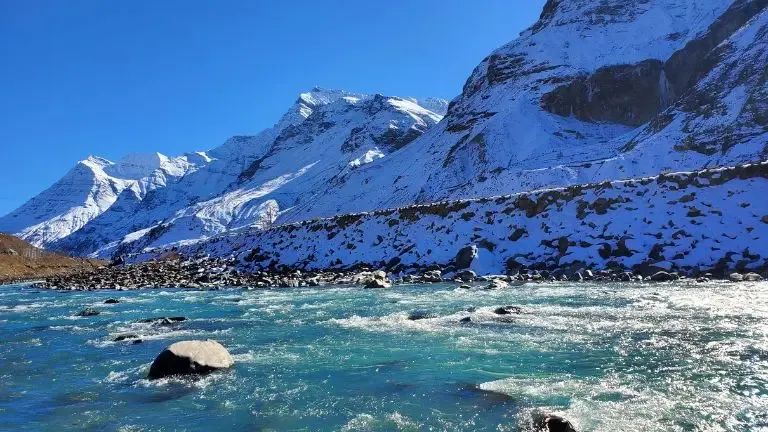
What has not changed is the country on the other side. It is dry, bare and layered — no trees at all above Sissu — and it looks and feels like Ladakh a great deal more than it looks like the valley twenty minutes behind you.
The half-hour that does all the work
Most people drive through the tunnel, look at Sissu for an hour, and drive back to Manali the same afternoon. That day trip is on the itinerary of half the operators in Kullu and it is a perfectly good use of a morning.
It is also the reason very few visitors have any idea what Lahaul is. Sissu is the first village on the far side and it is where the coaches turn round. Everything this trip is about — the confluence at Tandi, the Chandrabhaga cut, Trilokinath on its shelf, the carved cedar at Udaipur — is between one and three hours further on, on roads that no day trip has time for.
The distance is not the obstacle. Keylong is 70km from Manali. The obstacle is that a day trip has to come back.
Trilokinath, and why it is the stop we would not cut
A small temple on a spur above the Chandrabhaga, whitewashed, with a marble image inside that Hindus worship as Shiva and Buddhists as Avalokiteshvara. Both communities use it, on the same days, without any arrangement having been made about it.
Himachal has a great many temples and this is the only one we send people to specifically for what it is rather than for where it stands. The building is modest. What it is doing is not.
Udaipur is another forty minutes on and has the other thing worth the drive: the Mrikula Devi temple, whose interior woodwork is carved to a standard that has no business being in a valley this remote. Photography inside is restricted and enforced.
What the landscape is actually made of
Worth knowing before you arrive, because the first reaction to Lahaul is usually that something is missing.
There are no trees because there is no monsoon. The Pir Panjal takes it — the rain that makes Kullu green stops at the ridge you have just driven under, and Lahaul gets its water from snow instead. So the villages sit where a stream comes down and the irrigation reaches, in a green patch a few hundred metres across, and everything between them is rock.
The poplars and willows you do see at Sissu and Jispa were planted. The layering in the rock faces above the road is sedimentary, tilted and eroded, and in the afternoon light it is the most photographed thing on this trip after the river.
When to come, and when we would say no
June to early October, and the best of it is September. The valley is dry, the light is hard and clean, the barley and the pea crop are coming off, and the tourist traffic through the tunnel has thinned.
July and August are fine here — Lahaul is a rain shadow — but getting to Manali is not, and the Mandi–Pandoh stretch is the least reliable piece of road in the state in a heavy monsoon. We would rather move your dates than have you sit in it.
Day by day
How the 5 days run
- Day 18 hrs, 240km
Dharamshala to Manali
The drive that teaches everyone what mountain roads do to an average speed. Round the end of the Dhauladhar by Mandi and up the Beas. We stop properly for lunch rather than eating in the car, and there is nothing planned once you arrive.
- Day 270km, 3 hrs with stops
Through the tunnel to Keylong
Up past Solang to the south portal and through nine kilometres of tunnel that until 2020 was a 3,978m pass shut for half the year. You come out somewhere else entirely — no trees, bare layered rock, the Chandra running grey below. Sissu for the waterfall and the lake, Tandi where the two rivers meet, and into Keylong in the afternoon.
Show all 5 daysShow fewer days
- Day 33–4 hrs of driving in total
Trilokinath and Udaipur
Down the Chandrabhaga and up the far side. Trilokinath is a temple that Hindus and Buddhists both use and both are right about, standing on a shelf above the valley. Udaipur, further on, has the Mrikula Devi temple with wood carving inside it that nobody expects to find in Lahaul. The road is narrow and surfaced. Back to Keylong for the night.
- Day 4Under an hour each way
Up the Bhaga to Jispa
A short day on purpose. The valley opens above Keylong and the road runs on towards Baralacha and Leh, and Jispa at 3,200m is where everyone driving that road sleeps. We are not driving it — we go up for the morning, walk by the river, look at where the Leh trip carries on to, and come back. Kardang monastery above Keylong in the afternoon.
- Day 53 hrs to Manali, then 8 to Dharamshala
Back through, and home
Early through the tunnel to be ahead of the day traffic, and down. It is a long day and the honest options are to break it in Manali or to fly out of Bhuntar — both are on the table and we will say which we would do.
The price
What is in it, and what is not
Included
- Private car and driver for all five days, fuel, tolls and parking
- Four nights twin sharing with breakfast — one in Manali, three in Lahaul
- Pickup and drop in Dharamshala, or at Bhuntar or Chandigarh
- The driver's own food and accommodation
Not included
- Flights and trains
- Lunches and dinners
- Temple donations and camera fees
- Warm clothing, which you will want more of than you think
We do not publish a rate card. The number depends on the season, how many of you there are and the sort of hotels you want, so we price each trip on its own — and whatever we quote is what you pay.
Questions
What people ask about this one
Do we need a permit?
No. The Atal Tunnel is a public road and nothing in Lahaul needs paperwork. The permit people ask about is for Rohtang La, the old pass over the top, and that is a separate road we do not use on this route — it is worth doing for its own sake in July and August and we will arrange the permit if you want it.
Is it open in winter?
The tunnel is, most of the time. Lahaul beyond it frequently is not. Snow closes the road above Sissu, Keylong runs on its own arrangements from December, and the side roads to Trilokinath and Jispa are not reliable. We run this route June to October and we would rather turn the booking down than sell you a February version of it that spends four days in Manali.
How high do we sleep?
Keylong is about 3,080m and Jispa, which we visit but do not sleep at, is 3,200m. That is high enough that the first night is often a poor one and not high enough to be a medical problem for most people. Coming from Manali at 2,050m gives you one step rather than three, which is the reason day one is in Manali rather than driving straight through.
How is this different from your Manali to Leh trip?
That one uses this road for a morning and keeps going — Baralacha, Sarchu, the Gata loops, five thousand metres of pass. It is a road trip and the destination is Ladakh. This stops at Jispa and turns round, and spends its time in the side valleys instead: Trilokinath, Udaipur, Kardang. Same first two hours, completely different week.
Is there anywhere decent to stay?
Keylong has a handful of honest hotels and Jispa has camps. None of it is luxurious, some of it has intermittent hot water, and the power goes off. If that is a problem this is not your trip, and Manali with day runs through the tunnel is a better shape for you — we will build that instead.
Keep reading