
Destinations
Tabo and Dhankar
A thousand-year-old mud-brick monastery on the valley floor and a crumbling fortress gompa on a spur above it. The two oldest things in Spiti, forty minutes apart, and the reason to give the lower valley a night of its own.
Suits — anyone interested in what is inside the buildings, slow travellers, photographers
Read the full descriptionClose the description
Most people drive through the lower Spiti valley on their way to Kaza and give Tabo an hour. That is enough to see the outside of a mud-brick compound and conclude that it was not much to look at, which is a fair conclusion and entirely wrong. Everything here is inside.
Why Tabo is the one that matters
Spiti has more dramatic monasteries. Key is stacked up a hill and photographs better; Dhankar is on a cliff and looks like it is falling off. Tabo is a low brown compound on flat ground beside the road and looks like nothing at all.
What it has is age and continuity. It was founded in 996 and has been in use ever since, and — the part that is genuinely rare — nobody ever came along with money and repainted it. The murals and the clay figures in the assembly hall are original work, not a restoration of original work. There are very few places left where that sentence is true.
It takes a while for your eyes to adjust in there. Give it that while. People who walk in and out in ten minutes have seen a dark room.
Dhankar, and how much of it you can see
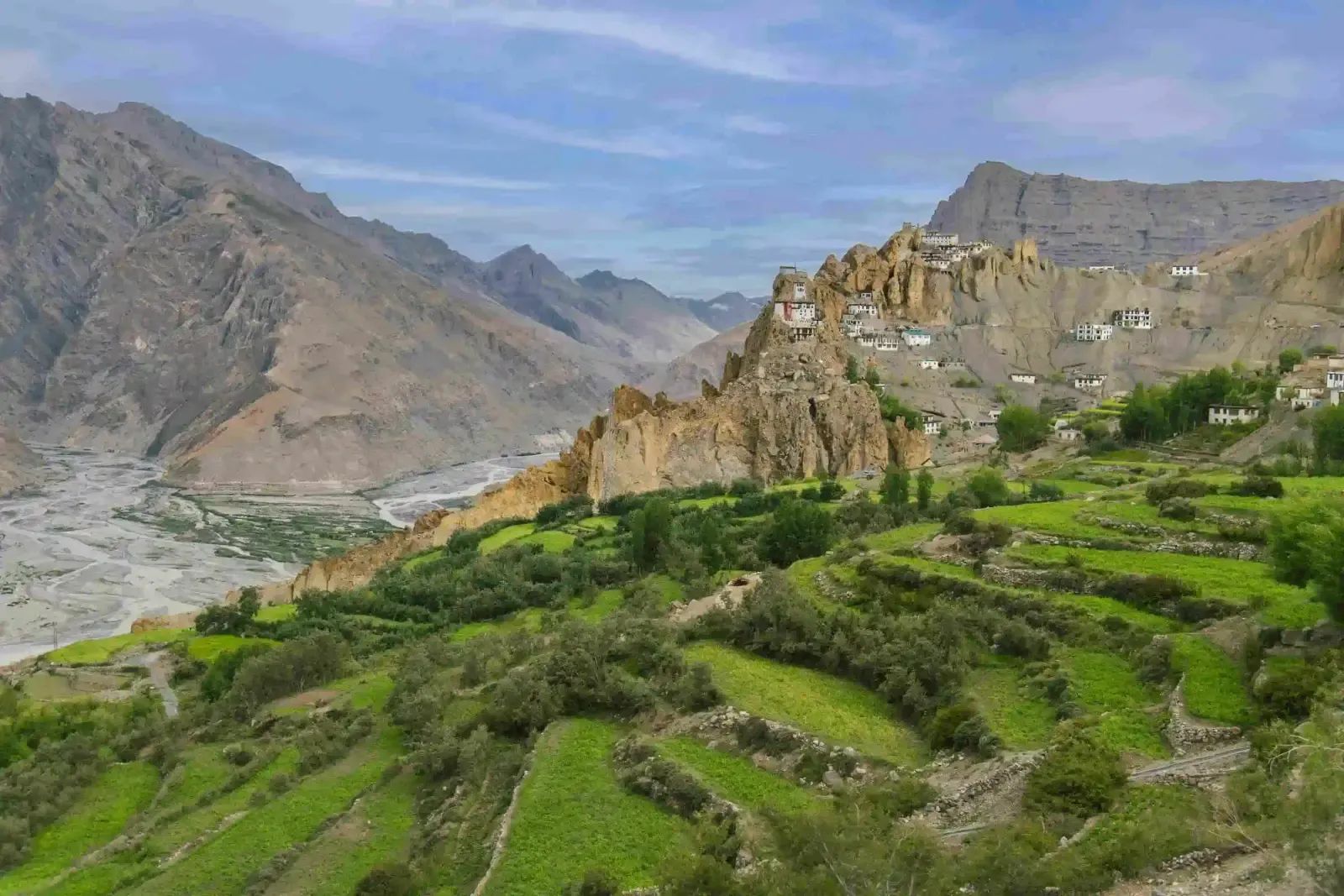
Dhankar is forty minutes up a side road from the valley floor and it is the more immediately impressive of the two: a fortified monastery on a spur of soft conglomerate, with the old blocks perched right on the edge and the rock visibly weathering out beneath.
That is also its problem. The old structure has been on international watch lists for years, sections are propped, and what is open to visitors changes. There is a newer gompa lower down which takes the daily use. Do not plan around getting into one particular room.
The walk up to the lake is the other half of a Dhankar visit and the half people skip. It is roughly an hour and climbs about 250 metres, from the monastery at 3,890 to the lake at 4,140, and it is harder than the distance suggests. If you have only just come up from Kinnaur, take it slowly or leave it.
Where this fits in a Spiti trip
Coming up from Kalpa it is a long day — 167 kilometres — and Tabo is the right place to stop rather than pushing the extra 47 to Kaza. You are lower here than you will be for the rest of the trip, which is the other argument for the night.
Going the other way, out towards Kinnaur, Tabo is the natural last stop before the descent.
Dhankar sits between Tabo and Kaza and works as a half day from either. Doing Tabo properly and Dhankar properly on the same day is possible and slightly rushed; the lake walk is what gets dropped.
A note on the winters
The Kinnaur road stays open all year because it never crosses a pass, so Tabo is technically reachable in January. Technically. The valley is at its most extraordinary under snow and it is also brutally cold, the guest houses mostly shut, and the road can close for days at a stretch after a storm. It is a real trip, but it is not this trip, and it needs planning of a different kind.
- Tabo founded
- 996 CE. Continuously in use since, which is the unusual part
- Dhankar altitude
- About 3,890m, on a spur between the Spiti and Pin rivers
- Tabo to Dhankar
- 31km, about an hour on the main valley road then a climb
- Dhankar to Kaza
- 27km. Tabo to Kaza direct is 47km
- Give it
- A night at Tabo. Dhankar is a half day from either end
- Best months
- May to October on the Manali side. The Kinnaur road reaches Tabo all year, though winter here is severe.
Worth your time
What to actually go and see
The Tabo wall paintings
The reason art historians come to Spiti. The interiors have never been repainted or restored, so what is on the walls is what was put there, and the clay figures standing out from the wall in the main hall are the same age as the building. It is dark inside on purpose — bring nothing that lights up.
The photography rule
There is no photography inside the old temples at Tabo and it is enforced rather than suggested. This is not a monastery being precious: unrestored mineral pigment is damaged by light, and the rule is why there is still something to look at. Leave the camera in the car and take the time you would have spent on it.
Dhankar gompa
Built as a fort as much as a monastery, on a spur of conglomerate that is visibly eroding out from under it. The old building has been shored up and parts of it are closed; a newer gompa sits below. Standing at the edge you can see the Spiti and the Pin meet, which is the best geography lesson in the valley.
Dhankar lake
An hour up from the monastery, and a genuine hour — 250 metres of climb ending at 4,140m, and people underestimate it because the distance is short. A small green lake in a bowl with the range behind it. Go in the morning.
The mud-brick problem
Everything old here is made of mud brick, which survives because it never rains. It rains now, a little, and both sites are in a slow argument with water they were never built for. Dhankar is on a watch list because of it.
Keep reading