
Tirthan, Jibhi and the Jalori pass
A trout river, a 3,120m pass with a lake an hour's walk from the top, and a valley that decided against becoming Manali. Four days of small roads and wooden villages with nothing much to tick off.
- Jibhi
- Jalori Pass
- Serolsar
- Shoja
Good for — Slow trips, walkers, people who work remotely, and anyone tired of hill stations
Read the full descriptionClose the description
The Tirthan is the valley people describe by saying what is not in it. No mall road, no ropeway, no sightseeing points with railings, no traffic at four in the afternoon. What there is instead is a clean river, a great deal of forest, and a handful of villages built out of the two materials that were to hand.
Four days is the shortest this makes sense in, because two of them are spent getting here and back. It is worth it.
Where the valley actually is
Confusingly, the place everybody calls Tirthan is two valleys.
The Tirthan proper runs east from Aut past Banjar to Gushaini, where the road stops at the boundary of the national park. That is the river, the trout and the walking. Jibhi is on a tributary that turns off a few kilometres earlier and climbs towards the Jalori pass, and it is where most of the guesthouses are — denser, more wooded, a little more organised.
We put you on the quieter side and drive to the busier one, which is the right way round. It also means the pass, which is the one thing here with a queue, is twenty-five minutes away rather than an hour.
The pass, and why we go early
The Jalori road climbs out of Jibhi to 3,120m in a very short horizontal distance, on tarmac just wide enough for one vehicle with passing places cut into the bank.
By eleven in the morning in season there are cars coming both ways and a good deal of reversing. At half past seven there is nobody, the light is across the ridge rather than behind it, and the oak forest on the Serolsar path still has mist in it. The same walk at two in the afternoon is a different and much worse thing.
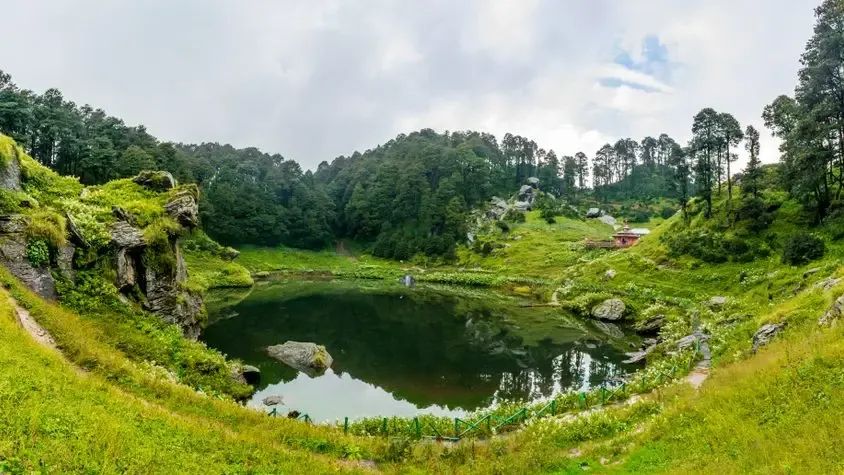
The lake itself is small and dark, with a temple to Budhi Nagin at the edge and no view to speak of. That is not the point of it. The point is the hour of level walking through mossy oak to get there, which is unlike anything else in the state.
Chehni Kothi is the thing nobody photographs
A tower house of dry-stacked stone and interleaved timber, standing on a spur above a village, reached only on foot. It was once around 45m tall — the top storeys came down in the 1905 Kangra earthquake — and it is still one of the tallest surviving buildings of its kind anywhere.
The walk up takes half an hour and goes through somebody’s village rather than to a monument, which is most of what makes it worth doing. There is no ticket and no guide. Look at the corner joints on the way past: the timber is laid in alternating courses with the stone precisely so the wall can move in an earthquake instead of falling down, and the building is the argument for it.
Who should not book this
Anyone who wants a full day. This trip has three or four fixed things in it and the rest is a river, and people who arrive with a list leave disappointed on day two.
Anyone travelling in July or August. The valley is beautiful in the monsoon and the road in is not — the Aut stretch is the one that closes, the Jalori climb is genuinely dangerous wet, and you will spend the week indoors watching it rain on the trees. Come in April for the blossom or in October for the light.
Day by day
How the 4 days run
- Day 17–8 hrs
Dharamshala to Jibhi
Down the Kangra valley and along to Mandi, then up the Beas through the Pandoh narrows and off the highway at Aut. The last hour is the good bit — a small road up the Tirthan with the river beside it the whole way. You are in a wooden guesthouse by the water for dinner.
- Day 245 min up to the pass
The Jalori pass and Serolsar
An early start, because the climb is steep, single track and much better before the day's traffic. Up through Shoja, which is the last village on this side and worth stopping in on the way down rather than the way up, to the pass at 3,120m with its small temple and a tea stall. From there it is about 5km east to Serolsar lake on a level path through old oak hung with moss — two hours there and back, and the best walking on this itinerary.
Show all 4 daysShow fewer days
- Day 3Short hops, nothing over 40 min
Chehni Kothi, and up the Tirthan
The tower at Chehni in the morning: stacked stone and timber, once around 45m tall and shortened by the 1905 earthquake, reached by a half-hour walk up through a village. The afternoon is the river — up to Gushaini where the road runs out, and a walk along the bank towards the park boundary.
- Day 47–8 hrs
Back down the valley
Out the way you came in, with a stop at the Pandoh reservoir and lunch at Mandi. Home in the evening.
The price
What is in it, and what is not
Included
- Private car and driver for all four days, fuel, tolls and parking
- Three nights in a guesthouse in the Tirthan valley, twin sharing, with breakfast
- Pickup and drop anywhere in Dharamshala or McLeod Ganj
- The driver's own food and accommodation
Not included
- Lunches and dinners
- Angling permits and tackle hire, which the guesthouses arrange
- Guide fees inside the national park, if you go in
- Anything you buy for yourself
We do not publish a rate card. The number depends on the season, how many of you there are and the sort of hotels you want, so we price each trip on its own — and whatever we quote is what you pay.
Questions
What people ask about this one
Is the Jalori pass always open?
No. It closes with the first real snow, usually some time in December, and reopens in March or April depending on the year — and it can shut for a few days in between at either end of that. Nothing else on this itinerary depends on it, so a winter trip here still works; you simply do not cross to Shoja and Serolsar. We tell you which it is in the week you travel rather than in theory.
Can we fish?
Yes, and this is one of the few rivers in Himachal where it is properly managed. Brown trout were introduced here and the Tirthan is run for them, on a licence the guesthouses arrange and largely catch-and-release. It is fly water, and if you have never cast one before somebody will show you.
How does this differ from your national park trip?
This one sleeps in a guesthouse every night and the longest walk is two hours. The park trip walks in past Gushaini with a guide and a permit, sleeps under canvas or in a forest hut, and is a proper four-day expedition on foot. Same valley at the bottom, entirely different week.
Is four days enough?
It is enough to see it. It is not enough to do what the valley is actually good at, which is nothing in particular for a week. People come here for three nights and stay for ten more often than anywhere else we send anyone, and if you have the time we would add nights here before adding them almost anywhere.
What is the road like beyond Aut?
Narrow and slow, but surfaced and perfectly ordinary in a car. The Jalori climb is the exception — single track, steep, with blind hairpins and no barrier in places. We do not drive it in the dark and we do not drive it in heavy rain.
Keep reading