
Destinations
Tirthan and Jibhi
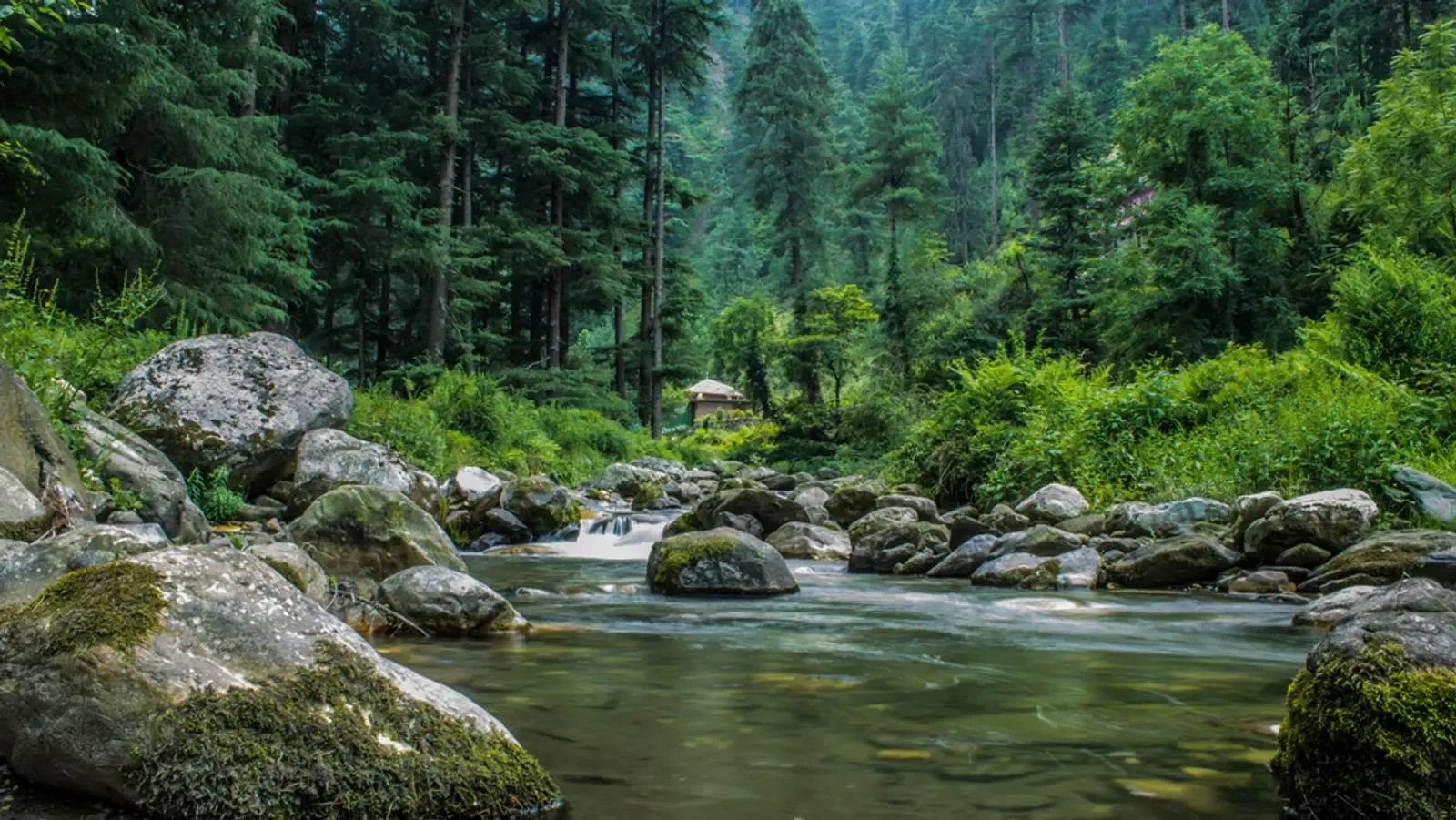
A side valley off the Kullu that the highway misses entirely. Trout in the river, a national park at the top of it, and rules that have kept the riverbank from being built on.
Suits — slow trips, walkers, working remotely, anyone tired of Manali
Read the full descriptionClose the description
Turn off at Aut, go through the tunnel, and the traffic disappears. The Tirthan comes down a valley that the Manali highway does not enter, and thirty years of development in Kullu largely passed it by.
Some of that is luck and some of it is rules. Construction close to the river is restricted, and the result is that you can still sit on the bank without a building in the frame — which in this state is now genuinely unusual. Most places to stay are wooden, small, family-run, and a short walk down from the road.
There is not a great deal to do, and the people who love this valley love it for that. The days available are: walk into the park boundary, walk to Serolsar from the pass, walk up to Chehni Kothi, fish, or sit by the river. That is the list.
Jalori Pass is the one thing to plan around. It is only 3,120m but the road to it is steep, narrow and unprotected, and it shuts under snow for a good part of the winter. If your route out is over the pass rather than back down to Aut, check before you commit to it — the alternative is four hours of retracing.
Jibhi and Gushaini are twenty minutes apart and get confused constantly. Jibhi sits on the road towards the pass and has the cafés; Gushaini is further up the Tirthan itself and is where you go if the river is the point.
- Altitude
- 1,600m at Gushaini, 3,120m at Jalori Pass
- Nearest airport
- Bhuntar, about 2 hours
- From Delhi
- 12–13 hours. It is a long drive and worth breaking
- Roads
- Narrow beyond Aut. The Jalori climb is steep and single track
- Give it
- Three nights minimum. People routinely stay a fortnight
- Best months
- March to June and September to November. Jalori Pass closes with snow, usually January to March.
Worth your time
What to actually go and see
The Great Himalayan National Park
The park boundary is at the head of this valley and Gushaini is the usual entrance. UNESCO listed in 2014 for its biodiversity. Going in past the ecozone means a permit and a registered guide, and day walks into the buffer need neither.
Jalori Pass
3,120m, and the fastest way between this valley and the Outer Seraj. The climb is short, very steep and unfenced. It closes under snow for much of the winter and reopens patchily in March.
Serolsar lake
A 5km walk east from the pass, mostly level, through old oak hung with moss. A small lake with a temple to Budhi Nagin at the edge. The path is easy and the forest is the reason to go.
Chehni Kothi
A tower house of stacked stone and timber near Jibhi, once around 45m tall and shortened by the 1905 earthquake. It is still one of the tallest traditional structures in the western Himalaya and is reached on foot from Shringa Rishi.
Trout in the Tirthan
Brown trout were introduced here and the river is managed for them. Angling is on a permit from the fisheries department, catch-and-release in the upper stretch, and several of the riverside places will arrange it.
Tirthan and Jibhi, photographed
6 photographs.


Keep reading