
Kullu, the Beas and the rafting stretch
The town everyone drives past on the way to Manali, given two nights. A fourteen-kilometre run down the Beas in a raft, a ridge temple at 2,460m, and the looms the shawls on the Mall Road are actually made on.
- Kullu
- Pirdi
- Bijli Mahadev
- Bhuntar
Good for — Families with teenagers, first-time rafters, and anyone who has done Manali twice
Read the full descriptionClose the description
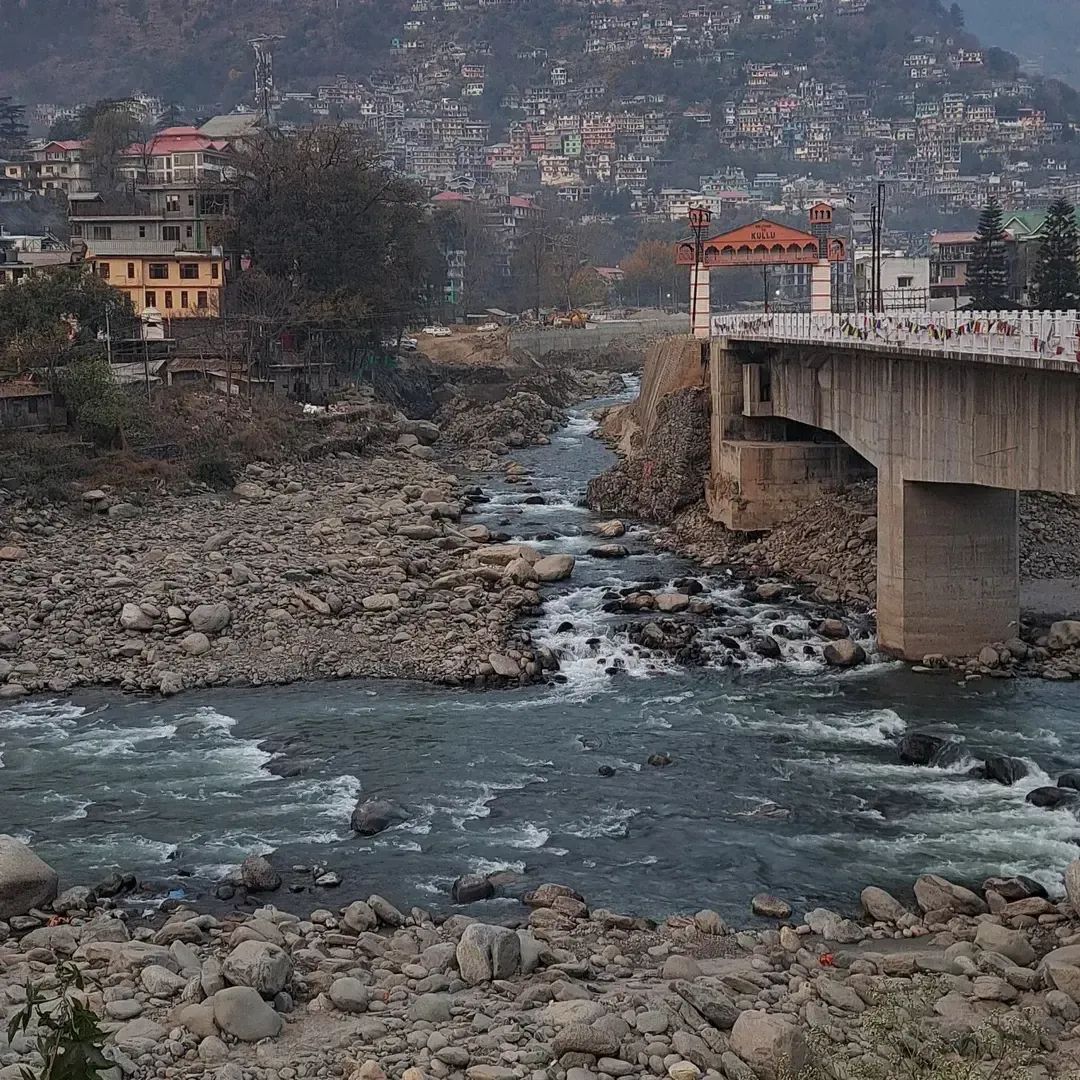
Kullu’s problem is its position. It is on the road to Manali, which means several thousand vehicles a day go through it and almost none of them stops, and what those people see is a bypass and a bridge.
Behind that there is a working district capital at 1,220m with the best beginners’ whitewater in north India running past it, a temple on a ridge above it that is worth the climb on its own, and the looms that supply every shawl shop between here and the Mall Road.
The river, and what grade II–III means
The commercial section is Pirdi to Jhiri, about fourteen kilometres, and it is the stretch nearly every operator in the valley runs.
Grade II is moving water with waves and clear channels. Grade III is bigger waves, some manoeuvring required, and the point at which a raft can be flipped by somebody doing the wrong thing. Neither involves drops, undercut rock or anything you would need experience for, which is why this is where India teaches people to raft.
You will get thoroughly wet and reasonably cold, both of which are better in the morning. Wear something quick-drying, leave your phone in the car, and accept in advance that the photographs you end up with will be the ones sold to you at the take-out.
Bijli Mahadev is the walk, not the story
A temple on the ridge that divides the Beas from the Parvati, at 2,460m, with a tall iron staff standing beside it.
The story everybody repeats is that the staff draws lightning, the lightning shatters the Shiva lingam inside, and the priest reassembles it with butter each time. Guidebooks print this without qualification. We would not.
What is not in any doubt is where the temple stands. Both rivers are below you, converging, with the whole Kullu valley on one side and the Parvati running back into the mountains on the other. It is the best viewpoint in the district and it costs you forty minutes of walking.
Buying a shawl where it is made
Every shawl sold in Manali was woven within about twenty kilometres of Kullu town and marked up on the way north. That is not a scandal, it is just how the trade works, and it does mean the sensible place to buy one is here.
Go somewhere with looms on the premises rather than a showroom on the highway. Ask for handloom and check the reverse of the border: on a handloom piece the pattern is worked into the cloth and the back is tidy in a particular way that a power loom does not reproduce.
Pashmina is a separate question and mostly is not from here at all. If somebody offers you pashmina at a Kullu price, it is not pashmina.
When not to come
July and August. The rafting is shut, the Pandoh stretch of the road in is the least reliable piece of highway in Himachal in heavy rain, and the valley spends a good deal of the week in cloud.
December to February works if the river is not the point — the town is warm enough by Himachal standards, Bijli Mahadev is clear and cold, and there is nobody about. We will happily build that trip. It is just a different one, and we would not sell it to you as this.
Day by day
How the 3 days run
- Day 16–7 hrs
Dharamshala to Kullu
Along the Kangra valley to Mandi and up the Beas through the Pandoh narrows. Kullu sits at 1,220m, which is a good deal warmer than Manali and one of the reasons to stay here instead. Raghunath temple in the evening — the image of Rama it holds was brought from Ayodhya in the seventeenth century and it is the deity the whole of Kullu Dussehra is arranged around.
- Day 215 min to the put-in
On the river
The run starts at Pirdi below Kullu and finishes at Jhiri, about 14km of grade II and III water with a briefing, a guide in every raft and a safety kayak on the section. It takes most of the morning. The afternoon is the shawl co-operatives, where you can watch a handloom running before you decide what a shawl is worth.
Show all 3 daysShow fewer days
- Day 32km on foot at the top, then 6–7 hrs back
Bijli Mahadev, then home
Up the ridge road early, then about two kilometres on foot to the temple at 2,460m. From the top the Beas and the Parvati are both laid out below you coming together, which is the reason to make the climb. Down by mid-morning and back to Dharamshala in the evening.
The price
What is in it, and what is not
Included
- Private car and driver for all three days, fuel, tolls and parking
- Two nights at Kullu, twin sharing, with breakfast
- The rafting — guide, helmet, buoyancy aid and the safety kayak
- Pickup and drop in Dharamshala, or at Bhuntar airport 10km away
Not included
- Lunches and dinners
- The video and photographs the rafting operators sell at the take-out
- Temple donations, and anything you buy at the looms
- Flights and trains
We do not publish a rate card. The number depends on the season, how many of you there are and the sort of hotels you want, so we price each trip on its own — and whatever we quote is what you pay.
Questions
What people ask about this one
Is the rafting safe for someone who has never done it?
The Pirdi to Jhiri stretch is graded II to III, which is the standard introductory water in India — waves and a few proper rapids, no drops, nothing technical. Everyone gets a briefing, a helmet and a buoyancy aid, and there is a guide in the boat and a kayak on the water. You should be able to swim, and you should tell us in advance if you cannot.
When does the river run?
March to June and again from September to about the end of October. It closes in the monsoon, when the Beas is carrying far too much water and the whole section is shut by the administration rather than by anybody's judgement, and it is too cold and too low to be worth doing in deep winter. Those are the months on the itinerary and they are not negotiable.
Why stay at Kullu rather than Manali?
Because the river is here, the ridge road is here and Manali is another hour and a half of traffic each way. Kullu is also 800m lower, which in April and October is the difference between an evening outdoors and an evening indoors. The trade is that Kullu has almost no restaurants and no nightlife of any kind.
Should we come for Dussehra?
If you can. It starts on the day Dussehra finishes everywhere else in India and runs for a week, and around two hundred village deities are carried in to the Dhalpur maidan. It is a genuine gathering rather than a show. It also fills the town completely, so rooms have to be held months ahead and the rafting operators are busy — tell us early and we will build around it.
How hard is the walk to Bijli Mahadev?
A road takes you most of the way and the last stretch is about two kilometres on a made path with steps, climbing steadily. Half an hour to forty minutes for most people, longer if you stop. It is not a trek and it is not flat, and in June it wants doing before nine in the morning.
Keep reading