
Destinations
Naggar and the left bank
The old capital of Kullu, halfway up the valley on the quiet side of the river. A castle built without nails, a Russian painter's house, and a road that most traffic no longer uses.
Suits — slow days, anyone tired of Manali, people who like old buildings
Read the full descriptionClose the description
Naggar is what the Kullu valley looked like before the Kullu valley became a destination, and it survives largely because the highway went up the other side of the river.
It was the capital for something like fourteen centuries — the seat moved down to Sultanpur at Kullu in the seventeenth — and what is left of that is a castle on a shelf with the whole valley below it and a set of temples further up the hill that predate the castle by a long way.
The castle, and what kath-kuni means
The building is the best reason to stop. It is built in the local style: courses of dressed stone alternating with long cedar beams, laid dry, pinned by their own weight, with no mortar and no iron.
That sounds like a folk detail and is actually structural engineering. The timber courses let the wall flex instead of shear, which is why buildings like this one have ridden out earthquakes that flattened later masonry beside them. Once you have noticed the pattern you will see it in every old village up this valley.
Part of the castle is a state-run hotel, and the rest is open. There is a small museum, a shrine with a slab of stone that has a story attached to it, and a courtyard with a view straight down the valley.
Roerich
Nicholas Roerich arrived in the 1920s and painted the Himalaya for the rest of his life. He was cremated on the estate in December 1947 and a stone on the hillside below the house marks the spot. The house itself is preserved with the furniture and the canvases in place, and there is a separate gallery and an art centre in the grounds.
You do not need to care about Russian symbolist painting to find this interesting. The paintings are of the ridge you can see from the garden, done in flat blocks of colour that look stylised until you stand on the terrace at six in the evening and realise they are quite literal.
Why the left bank is the better road
Between Kullu and Manali there is a road on each side of the Beas. Almost all traffic — buses, trucks, everyone in a hurry — takes the highway on the right bank. The left bank is narrower, slower and goes through the middle of villages and orchards, past Naggar and the shawl weavers.
It adds perhaps twenty minutes. It is a completely different experience of the same valley, and it is the single easiest improvement to make to a Kullu–Manali drive. We route this way by default unless there is a reason not to.
The road is single track in places with passing bays, and it is not the choice for a twenty-six-seater.
Staying here
There are guest houses and a couple of good small hotels, and a night at Naggar is a genuinely different proposition from a night in Manali twenty-three kilometres away: no traffic, no market, and the valley going quiet after dark.
For anyone who has done Manali once and found it busier than they wanted, this is the answer rather than going somewhere else entirely.
- Altitude
- About 1,800m, on a shelf above the Beas
- From Manali
- 23km. Under an hour on the left bank
- From Kullu
- 28km the other way, which makes it a stop rather than a detour
- Was the capital
- Of the Kullu kingdom, for roughly 1,400 years before Sultanpur
- Give it
- Half a day passing through, or a night if you want the valley quiet
- Best months
- March to November. April for blossom, October for the apple harvest and clear air.
Worth your time
What to actually go and see
Naggar Castle
A timber-and-stone building in the local kath-kuni style — alternating courses of cedar and dry masonry, no mortar and no nails, which is why it is still standing after several earthquakes. It was the royal residence, then a colonial courthouse, and is now partly a hotel you can walk into and look around.
The Roerich estate
Nicholas Roerich, the Russian painter, settled here in the 1920s and stayed. The house is kept as it was, with his Himalayan canvases on the walls — hard flat colour and enormous skies, painted from this hillside. There is a gallery in the grounds and the view from the terrace explains most of the paintings.
The temples above
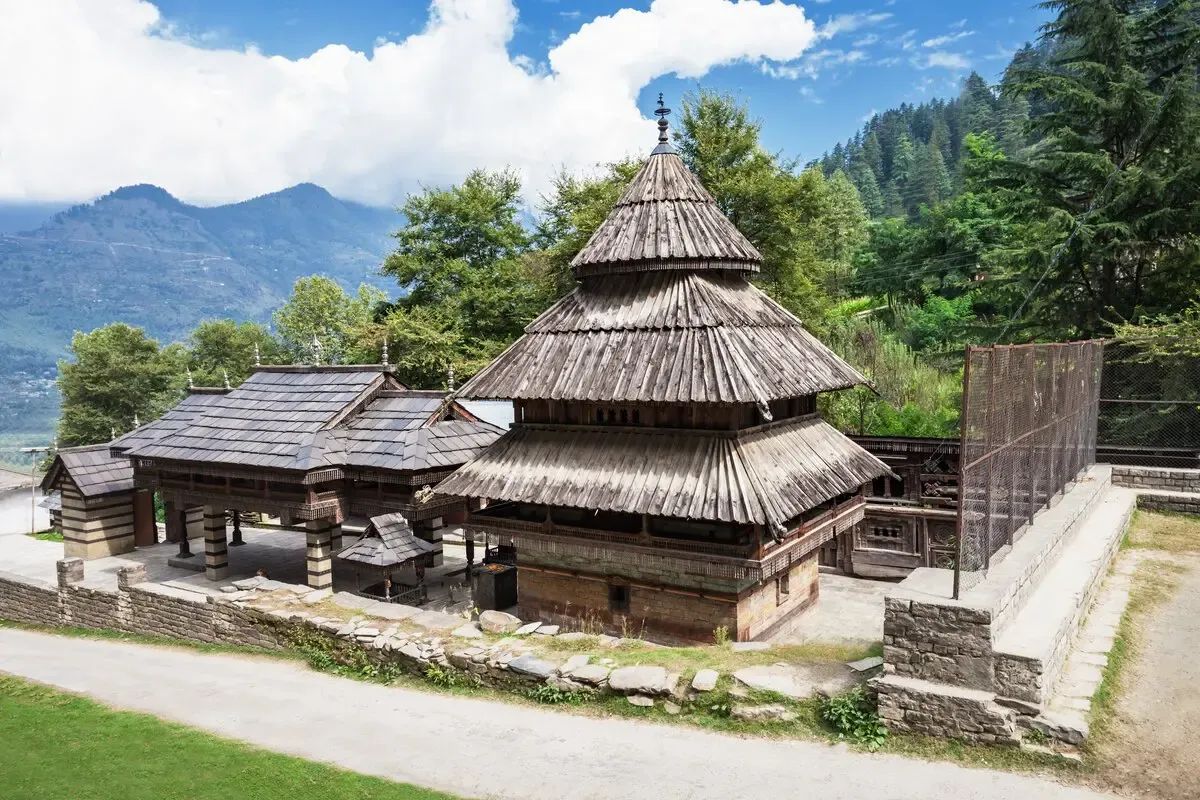
Tripura Sundari with its pagoda roofs, the Gauri Shankar shrine with old stone carving, and Murlidhar Krishna further up the hill. They are close together, all much older than the castle, and almost nobody visits them.
The left-bank road
Naggar is on the quieter of the two roads between Kullu and Manali, and that is most of why it still feels the way it does. Twenty minutes slower than the highway, and worth every one of them.
Apple country
This shelf is orchard from end to end. Blossom is late March and April, picking is September and October, and during the harvest every vehicle on the road is carrying crates.
Keep reading